
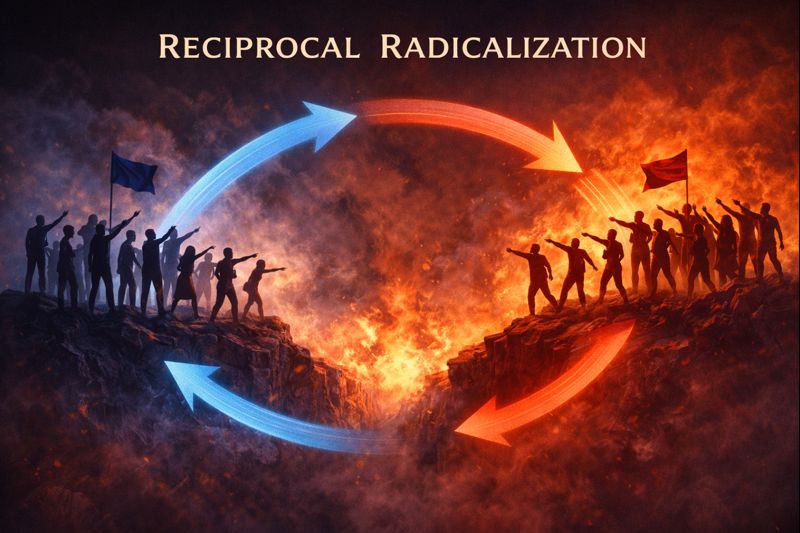
Reciprocal Radicalization
“Truth is the first casualty in war.” -Aeschylus
Reciprocal radicalization is the process by which opposing groups, individuals, or ideologies progressively drive one another toward greater extremes through cycles of fear, contempt, misinterpretation, and retaliation. Each side interprets the other’s behavior as proof of threat, corruption, or moral inferiority, which justifies escalating rigidity and aggression in return. Over time, the conflict ceases to be about truth, problem solving, or mutual understanding. It becomes about identity defense, symbolic dominance, and emotional discharge.
Psychologically, reciprocal radicalization emerges from the nervous system’s threat response. When people feel endangered, humiliated, or morally outraged, attention narrows, nuance collapses, and the mind seeks certainty and alliance. Complexity becomes intolerable. Ambiguity feels unsafe. The world is simplified into allies and enemies, good and evil, us and them. This cognitive contraction feels stabilizing in the short term, but it produces long term distortion and blindness.
What makes reciprocal radicalization especially dangerous is that both sides experience themselves as defensive and justified. Each escalation feels like a response rather than an initiation. Each side believes it is correcting the excesses of the other, while unknowingly becoming a mirror of the very pathology it condemns.
Observable Effects and Evidence
The effects of reciprocal radicalization appear consistently across psychology, sociology, political movements, religious schisms, and interpersonal conflict.
Common markers include:
- Increased certainty and decreased curiosity
- Moral absolutism and contempt for dissent
- Simplification of complex problems into slogans
- Emotional reactivity replacing thoughtful judgment
- Loss of empathy and humanization of the opposing side
- Group loyalty overriding individual conscience
- Identity fused with ideological position
- Escalating rhetoric and symbolic aggression
Neuroscience confirms that chronic threat activation suppresses the brain’s integrative and reflective capacities. Stress hormones narrow cognitive bandwidth. Memory becomes selective and biased toward threat confirmation. Emotional contagion spreads rapidly within groups. Over time, radicalized communities become self reinforcing echo systems that reward outrage and punish nuance.
Historical evidence is abundant. Revolutions often begin as corrective movements and end as mirror tyrannies. Religious conflicts repeatedly escalate through mutual demonization. Political factions harden into caricatures of one another. Tribal warfare perpetuates itself through generational grievance narratives. Even within families and workplaces, unresolved contempt produces escalating relational collapse.
The pattern is remarkably consistent because the underlying human nervous system has not changed.
Historical Examples
- The French Revolution illustrates reciprocal radicalization clearly. Initial resistance to monarchy evolved into revolutionary excess, which then produced reactionary backlash and authoritarian restoration. Each extreme justified itself by pointing to the excesses of the other.
- The Protestant Reformation likewise demonstrates the dynamic. Genuine concerns about corruption triggered reform movements, which hardened into sectarian absolutism, producing violent conflict and further entrenchment on all sides.
In the twentieth century, ideological polarizations between communism and capitalism, fascism and liberal democracy, generated feedback loops of propaganda, militarization, and paranoia that fueled global instability for decades.
On smaller scales, civil conflicts, gang rivalries, and even internet culture wars reproduce the same mechanism. Each side radicalizes the other through mutual threat amplification.
Biblical Illustration: Ephraim and Gilead
Scripture offers a striking symbolic example in the conflict between the tribes of Ephraim and Gilead in the book of Judges. After internal tribal warfare, the Gileadites controlled river crossings and used a linguistic test to identify fleeing Ephraimites. They asked travelers to pronounce the word “shibboleth.” The Ephraimites pronounced it “sibboleth,” revealing their identity and resulting in execution.
What began as political and tribal conflict devolved into dehumanization so extreme that pronunciation became a death sentence. Identity was reduced to symbolic markers. Nuance vanished. Brotherhood was forgotten. Fellow Israelites became disposable abstractions.
Psychologically, this illustrates radicalization perfectly. Once fear and grievance dominate perception, human beings become symbols rather than persons. Language itself becomes a weapon. The moral imagination collapses. Violence feels righteous.
The tragedy is not only the bloodshed but the blindness. The tribes could no longer recognize themselves in one another. The same covenant heritage, shared ancestors, and common God were eclipsed by hardened identity boundaries.
This pattern repeats endlessly in human history under different names and banners.
How Radicalization Distracts From Personal Growth
One of the most subtle dangers of reciprocal radicalization is how effectively it distracts individuals from their own development and responsibility.
When attention is consumed by ideological enemies, outrage cycles, and tribal signaling, energy is diverted away from:
- Physical health and discipline
- Relational repair and emotional maturity
- Vocational growth and skill development
- Financial stewardship
- Moral self examination
- Spiritual humility and repentance
- Psychological integration
Outrage feels meaningful without requiring growth. Tribal identity provides belonging without requiring character. Moral posturing substitutes for inner transformation. Blaming external enemies becomes easier than confronting internal weakness, fear, resentment, or irresponsibility.
Upward mobility, in every sense of the word, requires disciplined investment of attention, time, and energy.
Radicalization dissipates that capital into endless reactive loops. It flatens life trajectory by keeping individuals psychologically trapped in conflict narratives rather than developmental momentum.
In this sense, reciprocal radicalization is not merely a social problem. It is a spiritual and psychological poverty trap.
Snapping Out of Radicalization
Exiting reciprocal radicalization requires deliberate counter movement against instinctual patterns.
First, perception must be slowed. Emotional reactivity must be interrupted long enough for reflective awareness to return. This means limiting exposure to outrage driven media, resisting compulsive commentary, and creating silence for thought rather than stimulation.
Second, humanization must be restored. The opposing side must be consciously reimagined as composed of complex individuals with histories, fears, aspirations, wounds, and blind spots similar to one’s own. This does not require agreement. It requires recognition of shared humanity.
Third, personal responsibility must be reclaimed. Attention must be redirected toward one’s own life stewardship: physical health, relationships, vocational competence, emotional regulation, moral integrity, and spiritual growth. These domains are always more within one’s control than cultural battles.
Fourth, humility must be cultivated. Every human perception is partial and distorted. Certainty should be held lightly. Curiosity should replace contempt. Listening should replace performance.
Finally, compassion must reenter the moral imagination. Scripture consistently frames humanity as lost, wounded, and in need of grace rather than domination. Seeing one’s neighbor as a fellow lost soul dissolves the intoxicating clarity of enemy narratives and restores moral realism.
This does not mean abandoning convictions or boundaries. It means refusing to sacrifice one’s humanity, clarity, and inner freedom on the altar of tribal outrage.
Conclusion
Reciprocal radicalization is a predictable human pattern rooted in fear, identity threat, and cognitive narrowing. History, psychology, and scripture all testify to its destructive consequences. It degrades perception, corrodes empathy, fragments societies, and quietly robs individuals of the energy required for genuine growth and stewardship.
The antidote is not ideological victory but personal maturity. Clear perception, disciplined responsibility, relational compassion, and spiritual humility elevate the life trajectory beyond the gravitational pull of collective madness.
When we recover the capacity to see our neighbor as human again rather than symbolic enemy, we recover something even more important: the capacity to see ourselves truthfully, to grow wisely, and to live upward rather than reactively.
inter arma enim silent leges -Cicero