Assessments
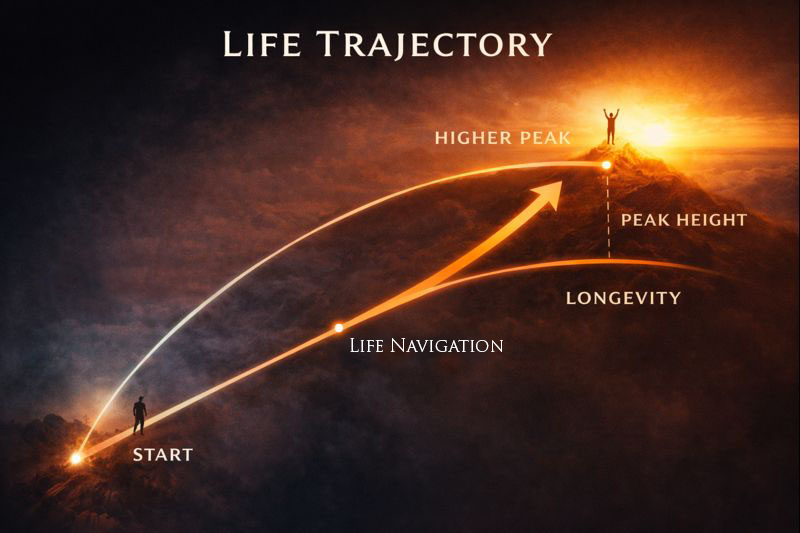
The Life Trajectory Assessment helps you evaluate the direction and quality of your life path, not just where you are today, but where your current patterns are taking you over time. It examines six foundational areas that shape long term peak performance and longevity: aim and meaning, physical health, secure relationships, discipline and self mastery, growth and competence, and support and accountability. Your scores reveal whether your habits are building upward momentum or quietly limiting your future. The goal is not perfection, but clarity, so you can identify your strongest foundations, expose your primary limiter, and make focused changes that raise the arc of your life trajectory.
The Inmost Being Assessment is a guided self examination designed to bring honest awareness to the deepest movements of the heart. It helps uncover hidden pain, false masks, avoided truths, unresolved anger, and the true longings that shape behavior beneath the surface. Rather than focusing on outward performance or surface level change, this assessment invites humility, reflection, and interior honesty so that false attachments can be released and authentic desires can be reoriented toward what is life giving and fruitful. The aim is not self judgment, but clarity, integration, and the steady cultivation of a truthful inner life.

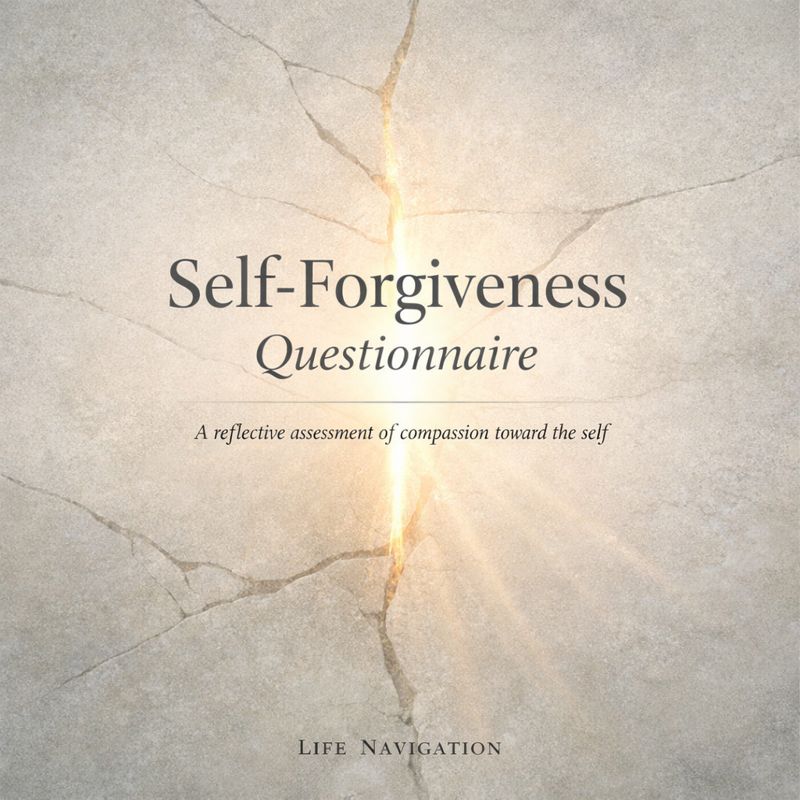
Self forgiveness is not about excusing the past or minimizing harm. It is about ending the internal war that keeps wounds open long after responsibility has been taken. Many people unknowingly relate to themselves with the same contempt, distrust, and withdrawal that erode intimate relationships, driven by a deep belief that they are unworthy of patience, understanding, or care. This questionnaire is designed to help you examine how you respond to your own failures, regrets, and unmet needs, and whether self criticism and self protection have replaced compassion and truth. Its purpose is not self judgment, but awareness, offering a clearer picture of where forgiveness has been withheld from yourself and where healing can begin.
Many people equate emotional maturity with self denial, endurance, or relentless sacrifice, yet wisdom repeatedly frames the human heart as something entrusted to our care. Self neglect often disguises itself as virtue, while stewardship requires courage, attentiveness, and restraint. This questionnaire is designed to help you examine how you relate to your own needs, limits, and inner life.


Many people mistake intensity for intimacy. Intense emotions, passion, urgency, and dramatic connection can feel like depth, yet they often arise from insecurity, fear of abandonment, or unmet needs rather than genuine closeness. Intimacy, by contrast, develops slowly. It requires safety, honesty, patience, and the willingness to be known over time. This questionnaire is designed to help you examine whether your relationships are driven primarily by emotional intensity or by true intimacy.
The Authenticity vs. Attachment questionnaire is designed to help individuals examine whether their thoughts, emotions, and behaviors are primarily guided by inner truth or by the need for approval, security, and belonging. Authenticity reflects alignment with one’s genuine values, feelings, and convictions, even when doing so carries relational or emotional risk. Attachment, in this context, refers to the tendency to organize one’s identity around external validation, fear of loss, or the need to maintain connection at the expense of honesty.


Unconditional self-regard is the foundation of how you lead, relate, and make decisions. It reflects whether your sense of worth is stable and grounded, or dependent on performance, approval, and external outcomes. Many people operate with an internal relationship shaped by criticism, pressure, or conditional acceptance, which creates instability beneath the surface. This assessment is designed to help you examine how you actually relate to yourself in moments of stress, failure, and growth. It is not meant to judge or diagnose, but to bring clarity. Lasting alignment begins with how you see and treat your own inmost being.
The Navigating Fear Assessment is designed to help you identify and understand the specific fears that influence your decisions, relationships, and overall trajectory. Rather than treating fear as a single emotion, this assessment breaks it into distinct domains such as intimacy, rejection, failure, success, control, safety, emotional pain, significance, abandonment, and self-confrontation. By examining how these fears show up across different areas of life, you gain clarity on the underlying patterns that may be driving avoidance, overcompensation, or reactivity. The goal is not to eliminate fear, but to bring it into awareness so it no longer operates unconsciously, allowing you to respond with intention rather than being directed by unseen internal pressures.

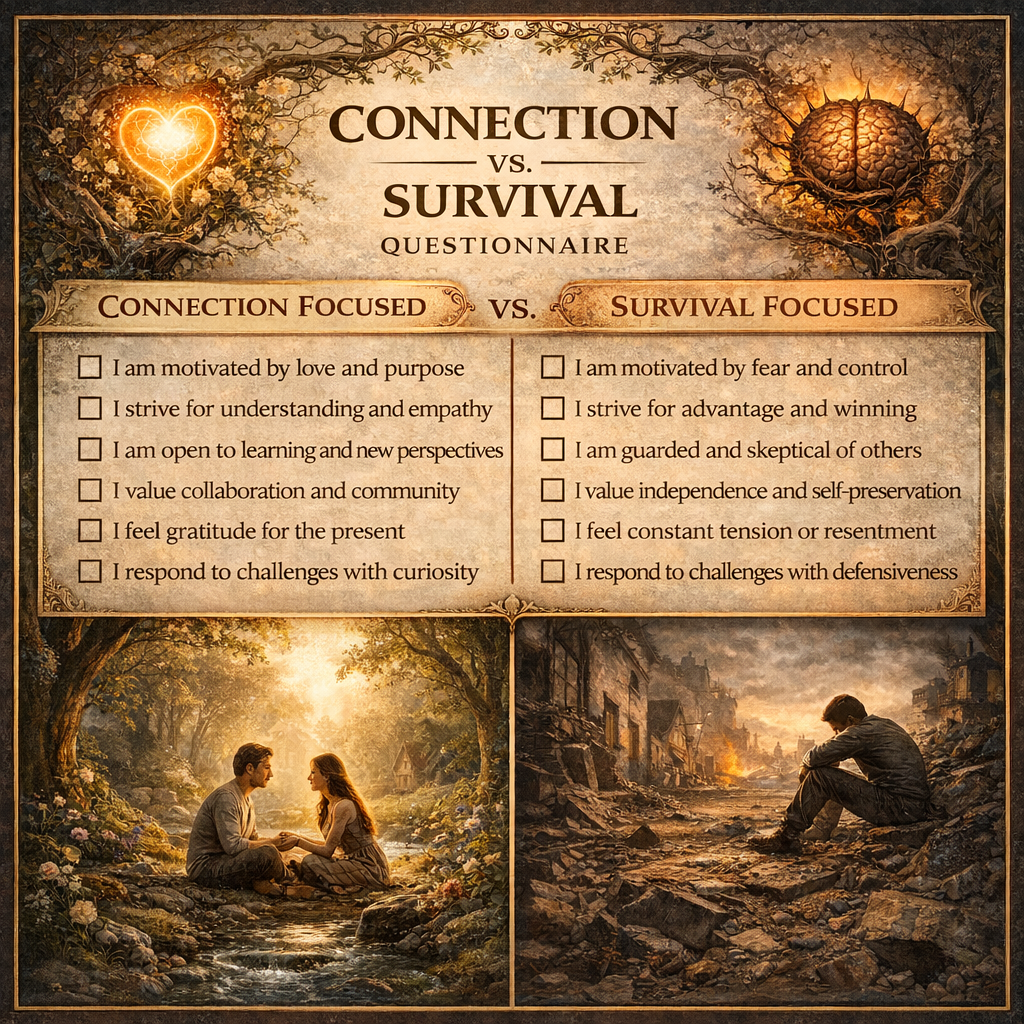
From the moment we enter the world, our nervous systems begin adapting to our environment. Some of us are shaped in contexts where connection feels safe and reliable. Others grow up in conditions where vigilance, self-reliance, or emotional restraint become necessary for survival.
This questionnaire is designed to help you explore which orientation has most shaped your inner world. It is not meant to label or judge, but to bring awareness to the strategies your nervous system learned in order to survive and relate.
The Humility vs. Superiority assessment is designed to help you examine how you relate to yourself, others, and reality through the lens of ego and perception. This scale explores whether your internal posture is grounded, open, and reality-oriented, or shaped by comparison, defensiveness, and the need to elevate or protect your identity. Because superiority is often subtle and internal, it can operate unnoticed, influencing how you interpret interactions, respond to feedback, and engage in relationships. This assessment is not meant to judge, but to bring awareness to patterns of self-focus and personalization that can limit growth. As humility increases, perception becomes clearer, reactivity decreases, and relationships deepen, allowing you to move through life with greater stability, openness, and connection.

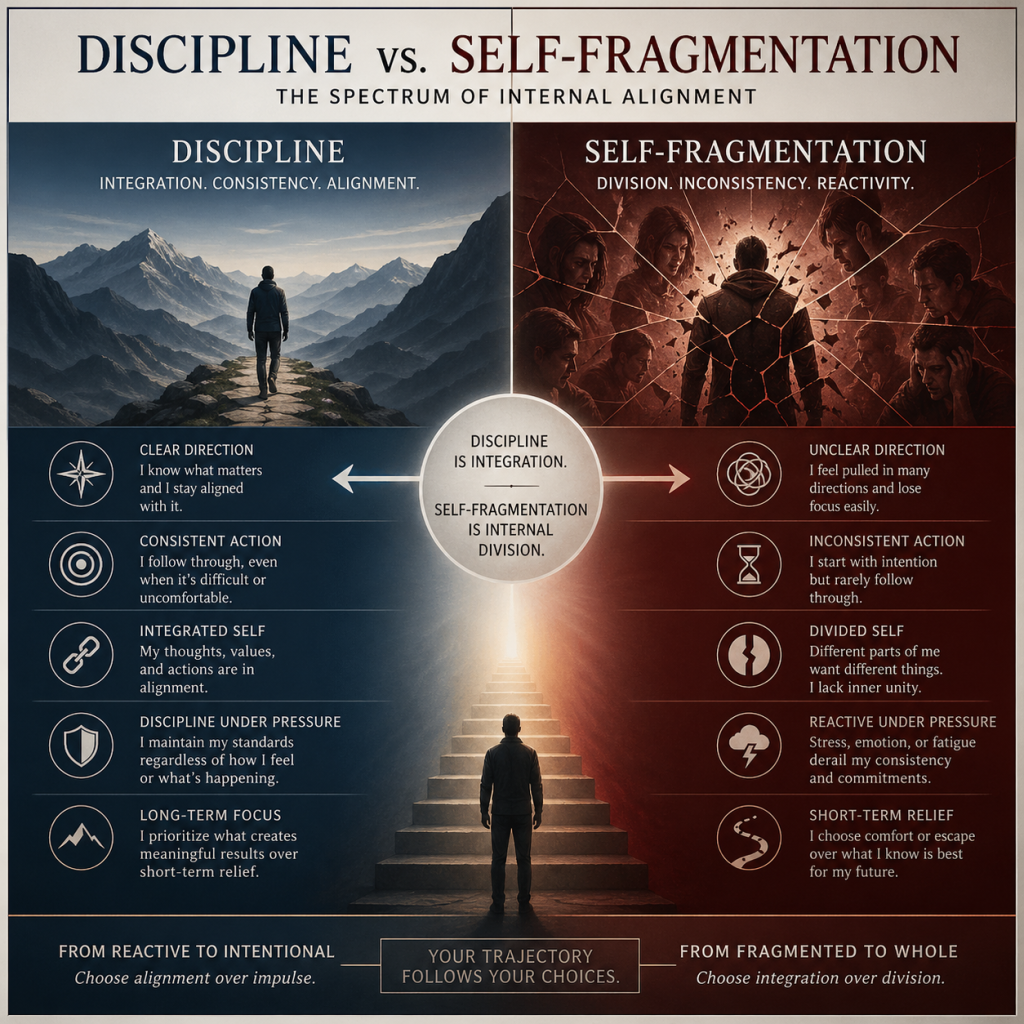
Discipline is not simply effort or willpower, but the result of internal alignment, where thoughts, values, and actions move in the same direction. Self fragmentation, by contrast, is the experience of being divided within, pulled by competing impulses, emotions, and priorities that lead to inconsistency and drift. Most struggles with discipline are not failures of motivation, but symptoms of this deeper misalignment. As awareness increases, a person can begin to integrate these divided parts, acting more consistently with what they know to be true. Over time, this shift from fragmentation to alignment creates stability, clarity, and a steady trajectory forward.
This assessment is designed to help individuals evaluate how they unconsciously perceive and relate to other people. At one end of the spectrum, people are primarily viewed through the lens of usefulness, status, gratification, ideology, or obstruction. At the other end, people are viewed as inherently valuable individuals with dignity, complexity, emotions, fears, hopes, and equal worth.


Take the Assessment
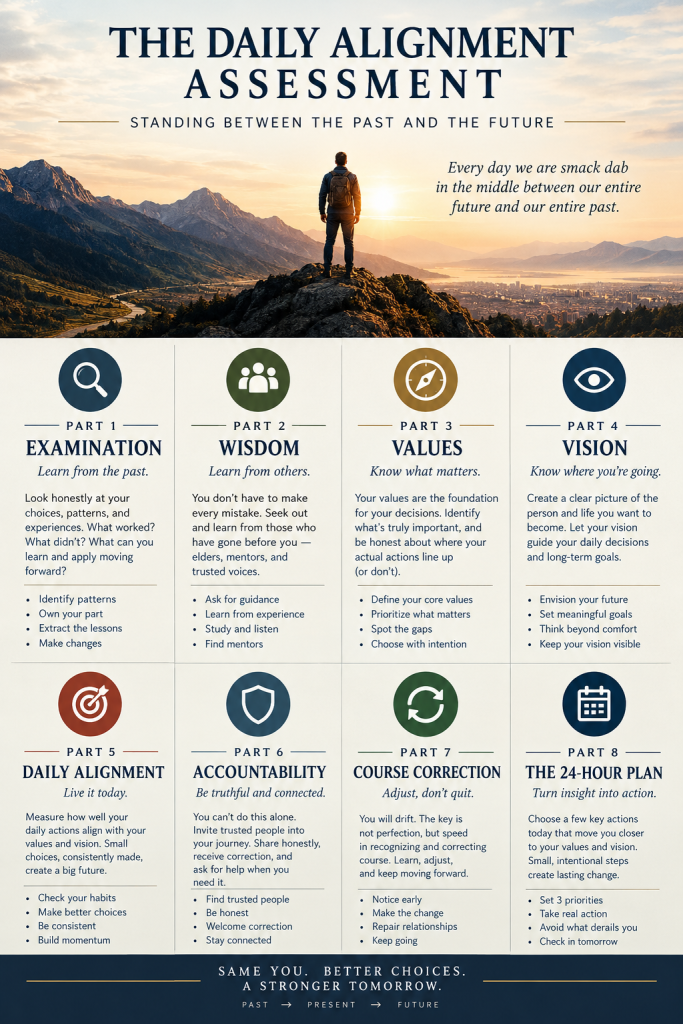
“Every day, we are directly in the middle between our entire future and our entire past.”
Every morning we awaken at the boundary between two enormous realities. Behind us is everything that has already happened: our successes, failures, relationships, losses, mistakes, victories, consequences, lessons, and accumulated wisdom. Ahead of us is everything that might still happen: the person we might become, the relationships we might build, the work we might accomplish, the people we might serve, and the life we might create.
We cannot return to yesterday, and we cannot act directly upon tomorrow.
We can only act today.
The purpose of this assessment is to determine how effectively you are using wisdom from the past and vision for the future to direct your behavior in the present.