
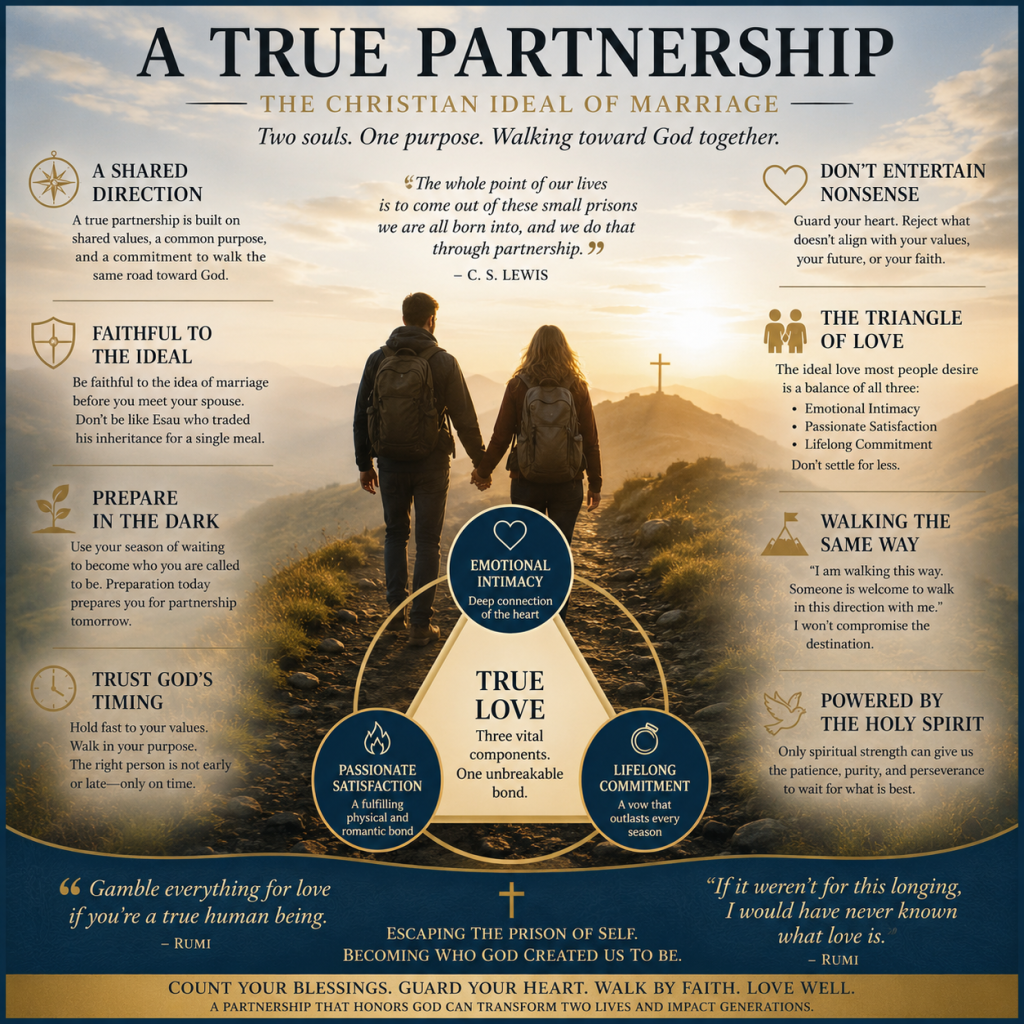
A True Partnership: The Christian Ideal of Marriage
One of the greatest misunderstandings about marriage is the belief that it exists primarily to make us happy. While joy, companionship, intimacy, and fulfillment are certainly gifts of marriage, they are not its highest purpose. The Christian vision of marriage is far more profound. Marriage is the formation of a true partnership between two people who are moving toward God together. It is not merely a legal arrangement, a romantic attachment, or a solution to loneliness. It is a shared journey of transformation.
A true partnership exists when two individuals voluntarily unite themselves around a common direction, a common purpose, and a common set of values. It is not enough for two people to simply enjoy one another’s company. They must be moving toward the same destination. The strength of a partnership is not measured by how intensely two people feel about one another in a particular moment, but by whether they remain committed to walking the same road over time.
This is why shared vision matters so deeply. Many relationships fail because people are attracted to one another but are ultimately pursuing different destinations. One person seeks comfort while the other seeks growth. One seeks God while the other seeks autonomy. One seeks service while the other seeks self-gratification. Temporary attraction may bridge these differences for a season, but eventually the direction of travel becomes more important than the intensity of emotion.
The Christian life itself is a journey out of the small prisons into which we are all born. We enter the world trapped within our fears, selfishness, wounds, pride, illusions, and limited perspectives. As we mature, God continually calls us beyond ourselves. We are invited to become more loving, more courageous, more humble, more truthful, and more capable of sacrifice. Marriage becomes one of the primary vehicles through which this transformation occurs.
As C. S. Lewis observed in various ways throughout his writings, the Christian life is not about becoming comfortable but becoming transformed. The purpose of life is not self-preservation but sanctification. A healthy marriage accelerates this process because another human being sees our blind spots, challenges our selfishness, encourages our growth, and reminds us of who we are capable of becoming. A true partner helps us escape the prison of ourselves.
This is why marriage begins long before two people meet. Most people think faithfulness begins on the wedding day.
In reality, faithfulness begins in private. It begins in the decisions we make when no one is watching. It begins in the standards we establish before temptation arrives. It begins in the vision we refuse to compromise.
A person who desires a godly marriage must become faithful to the idea of marriage before they ever meet their spouse. They must determine the direction of their life and commit themselves to it. They must learn to reject relationships, habits, and opportunities that would pull them away from that destination.
The Scriptures warn us not to be like Esau, who traded his inheritance for a single meal. In a moment of hunger, he surrendered something eternal for something temporary. Many people make a similar mistake in relationships. Loneliness arrives. Desire intensifies. Fear of being alone grows. In that moment, they trade their vision for companionship, their values for comfort, or their future for temporary relief.
Yet a true partnership cannot be built upon compromise with one’s deepest convictions.
The individual who desires a lasting marriage must learn to say:
“I know where I am going.”
“I know who I am becoming.”
“I know what I value.”
“You are welcome to walk with me, but I cannot abandon the road God has placed before me.”
This is not arrogance. It is clarity. It is the recognition that a relationship should strengthen one’s purpose rather than replace it. Modern psychology offers a useful framework known as the Triangular Theory of Love. According to this model, love consists of three essential components: intimacy, passion, and commitment. Intimacy refers to emotional closeness and vulnerability. Passion refers to attraction and desire. Commitment refers to the decision to remain faithful over time.
Most people desire all three. They want emotional intimacy. They want passionate connection. They want lifelong commitment. The tragedy is that many settle for one or two of these while sacrificing the others. Some choose passion without commitment. Some choose commitment without intimacy. Some choose intimacy without passion. Yet the deepest longing of the human heart is to experience all three simultaneously.
The Christian vision of marriage does not reject this longing. It elevates it.
The goal is not merely to find someone who excites us. The goal is to find someone with whom we can build a life, share our deepest selves, and remain faithful through every season. This requires patience. Perhaps one of the most difficult spiritual disciplines in modern life is waiting. Waiting without becoming bitter. Waiting without becoming cynical. Waiting without compromising. Waiting without settling.
The culture constantly urges immediate gratification. It tells us that loneliness should be relieved immediately, that desires should be satisfied immediately, and that discomfort should be avoided at all costs.
The Christian path often asks something different. It asks us to wait. To prepare. To trust. To become. Many people spend their lives searching for the right person while neglecting the process of becoming the right person.
The wiser path is preparation. Preparation in private. Preparation in obscurity. Preparation in the dark.
The farmer prepares the field before the harvest arrives. The athlete trains before the competition. The believer develops character before the opportunity appears. The same principle applies to marriage. The season of waiting is not wasted. It is preparation. Each act of self-control, growth, healing, forgiveness, discipline, and spiritual formation is preparing the soul for partnership.
The great Persian poet Rumi wrote, “Gamble everything for love if you’re a true human being.”
This statement is often misunderstood. It does not mean recklessly pursuing romance. It means recognizing that love is one of the highest aims of human existence. Love requires vulnerability. Love requires sacrifice. Love requires courage. Love requires the willingness to risk comfort for something greater.
Rumi also observed, “If it weren’t for this longing, I would have never known what love is.”
Longing itself can become a teacher.
The ache for connection reveals something about the human soul. It reminds us that we were created for relationship. Yet longing also teaches patience, dependence, humility, and trust. It teaches us to distinguish between desire and desperation. The mature person learns to hold longing without allowing longing to control them. This is where spiritual strength becomes essential.
Human strength alone is often insufficient to endure prolonged waiting. The individual eventually becomes exhausted by loneliness, disappointment, or uncertainty. The Christian believes that the Holy Spirit provides a different kind of strength. Not merely the strength to endure, but the strength to remain faithful. Faithful to one’s values. Faithful to one’s vision. Faithful to one’s purpose. Faithful to God’s timing.
The Spirit provides the ability to sit with uncertainty without surrendering hope. It allows a person to reject lesser alternatives while remaining open to the possibility of something greater. A true partnership is not created by two desperate people rescuing one another from loneliness. It is created by two individuals who have chosen a direction, committed themselves to growth, and remained faithful to their values long before they met.
Eventually, paths cross. Eventually, two people recognize the same destination. Eventually, two lives become one journey. And when that occurs, marriage becomes what it was always intended to be: a partnership between two people helping one another move toward God, escape the prison of self, and become more fully who they were created to be.