
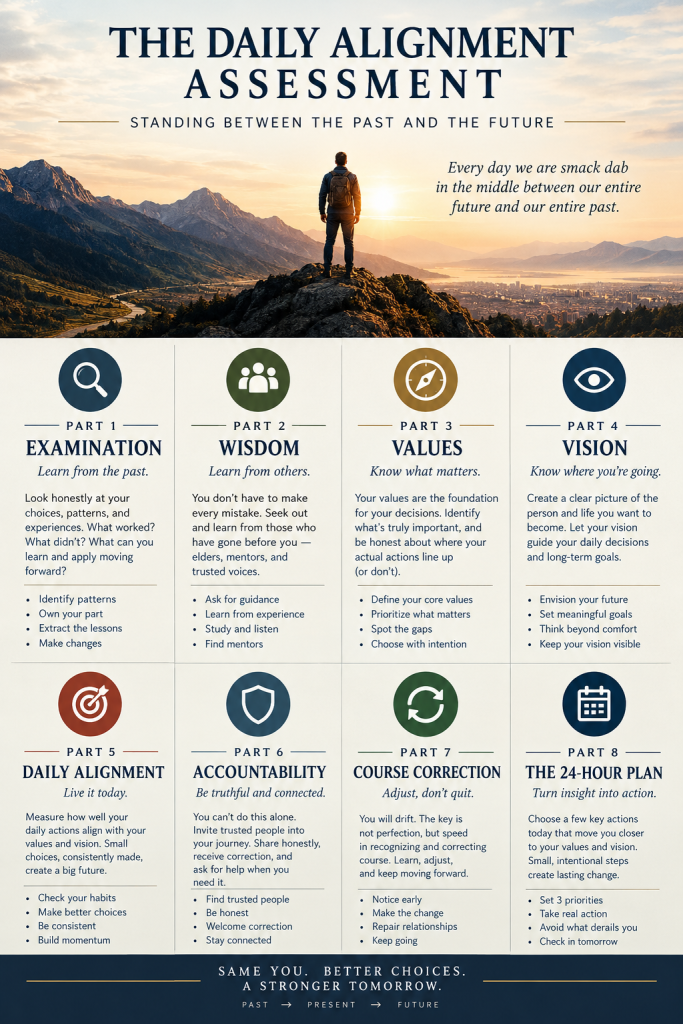
THE DAILY ALIGNMENT ASSESSMENT
Standing Between the Past and the Future
“Every day, we are directly in the middle between our entire future and our entire past.”
Every morning we awaken at the boundary between two enormous realities. Behind us is everything that has already happened: our successes, failures, relationships, losses, mistakes, victories, consequences, lessons, and accumulated wisdom. Ahead of us is everything that might still happen: the person we might become, the relationships we might build, the work we might accomplish, the people we might serve, and the life we might create.
We cannot return to yesterday, and we cannot act directly upon tomorrow.
We can only act today.
The purpose of this assessment is to determine how effectively you are using wisdom from the past and vision for the future to direct your behavior in the present.
THE PRINCIPLE OF SCARCITY
Human life is governed by scarcity.
You possess a finite amount of time, energy, attention, money, health, and opportunity. Every hour spent doing one thing is an hour unavailable for something else. Every dollar spent represents resources that cannot simultaneously be allocated somewhere else. Every relationship requires some portion of your emotional energy. Every commitment consumes some portion of your life.
This means that every choice is also a sacrifice.
To say yes to one thing is inevitably to say no to countless others.
The question, therefore, is not simply:
“What do I want?”
A more mature question is:
“What is important enough that I am willing to spend part of my finite life on it?”
Your actual priorities are eventually revealed by where your scarce resources go.
Look at your calendar.
Look at your bank account.
Look at your screen time.
Look at your physical habits.
Look at your closest relationships.
Look at what occupies your thoughts.
Look at what receives your best energy.
These often reveal your functional values more accurately than what you say you value.
PART I — THE ALIGNMENT ASSESSMENT
Rate each statement from 1–5.
1 — Almost Never
2 — Rarely
3 — Sometimes
4 — Usually
5 — Almost Always
A. EXAMINATION — LEARNING FROM THE PAST
___ I regularly examine my recent decisions rather than simply moving on from them.
___ I can identify patterns in my life that repeatedly produce good or bad outcomes.
___ I am willing to acknowledge when my own choices contributed to a problem.
___ I can examine mistakes without immediately becoming defensive, ashamed, or blaming others.
___ I intentionally repeat behaviors that experience has shown to be beneficial.
___ I intentionally discontinue behaviors that experience has shown to be destructive.
___ I ask myself what difficult experiences are trying to teach me.
___ I make meaningful changes after recognizing a recurring problem.
Examination Score: ____ / 40
B. WISDOM — LEARNING FROM THOSE WHO CAME BEFORE ME
Youth naturally possesses something age gradually takes away: naiveté.
This is not an insult to the young. It is an unavoidable condition of being inexperienced. There are things that cannot be fully understood until they have been lived. One of the great advantages human beings possess, however, is that we do not have to personally make every mistake in order to learn from it.
Wisdom can be inherited.
Parents, grandparents, mentors, veterans, teachers, craftspeople, spiritual leaders, healthy couples, successful professionals, and elders can allow us to see farther because they have traveled farther.
The wise person therefore asks not only, “What have I learned?” but also:
“What have others learned that I would be foolish to learn the hard way?”
___ I deliberately seek advice from people with more experience than I have.
___ I have people in my life who are willing to tell me uncomfortable truths.
___ I consider the long-term consequences observed by older and more experienced people.
___ I distinguish between someone who merely has opinions and someone whose life demonstrates wisdom.
___ I study biographies, history, Scripture, philosophy, research, or other accumulated sources of human wisdom.
___ I am willing to reconsider my assumptions when experienced people challenge them.
___ I seek mentors whose lives demonstrate qualities I want to develop.
___ I recognize that intelligence does not eliminate the limitations of inexperience.
Wisdom Score: ____ / 40
C. VALUES — KNOWING WHAT MATTERS
Values are not simply things you like.
A value is a principle, relationship, responsibility, or way of being that you consider important enough to guide your choices and justify sacrifice.
Examples might include:
Faith • Family • Integrity • Health • Courage • Service • Discipline • Love • Freedom • Responsibility • Loyalty • Learning • Financial Stewardship • Friendship • Excellence • Compassion • Adventure • Stability • Truth • Creativity • Community
___ I can clearly identify my most important values.
___ I understand why those values matter to me.
___ I can distinguish my values from immediate wants, impulses, and appetites.
___ I can distinguish my values from expectations imposed upon me by other people.
___ When two desirable things conflict, I can usually determine which deserves priority.
___ My calendar generally reflects my stated values.
___ My spending generally reflects my stated values.
___ My relationships generally reflect my stated values.
___ I am willing to sacrifice lower priorities to protect higher priorities.
___ I periodically reconsider whether the way I am living reflects what I truly believe matters.
Values Score: ____ / 50
IDENTIFY YOUR CORE VALUES
Write 10 things that currently seem most important to you.
Now comes the difficult part.
Scarcity requires hierarchy.
If everything is equally important, nothing can actually be prioritized.
Reduce your list to your five highest values.
Now force yourself to rank them.
My Present Value Hierarchy
1. __________________________
Why does this deserve such a high place?
2. __________________________
Why?
3. __________________________
Why?
4. __________________________
Why?
5. __________________________
Why?
Now ask:
What would someone observing my life conclude my five highest values actually are?
Compare the two lists.
Where is the greatest discrepancy?
What is receiving resources that I claim belongs to something more important?
D. VISION — KNOWING WHERE I AM GOING
___ I have a reasonably clear picture of the person I want to become.
___ I have thought seriously about what I want my life to look like several years from now.
___ My vision includes more than career achievement or material possessions.
___ I have considered the future of my physical health.
___ I have considered the future of my relationships and family.
___ I have considered my spiritual and moral development.
___ I have considered my financial future.
___ I have considered my vocation, service, and contribution to others.
___ I regularly consider whether today’s behavior is compatible with that future.
___ My vision is clear enough to influence ordinary daily decisions.
Vision Score: ____ / 50
E. DAILY ALIGNMENT — LIVING IT TODAY
___ My ordinary daily behavior moves me toward the future I say I want.
___ I make important decisions according to values rather than temporary emotions.
___ I willingly tolerate short-term discomfort for long-term benefit.
___ I protect time for the people I claim are important.
___ I take reasonable care of my physical body.
___ My eating and substance-use behaviors are consistent with my long-term goals.
___ My spending and saving behaviors reflect my financial priorities.
___ My vocational behavior reflects the person and professional I want to become.
___ My private behavior is reasonably consistent with the person I claim to be publicly.
___ I regularly do things today that my future self will benefit from.
Daily Alignment Score: ____ / 50
F. ACCOUNTABILITY — ALLOWING MYSELF TO BE KNOWN
Self-examination has limitations because human beings are remarkably capable of rationalizing their own behavior.
Accountability introduces another set of eyes.
A spouse, partner, trusted friend, mentor, counselor, pastor, coach, sponsor, support group, or other trustworthy community can sometimes recognize our drift before we do.
Accountability requires more than having people around us. It requires allowing ourselves to be truthfully known.
___ At least one trustworthy person knows what I am currently struggling with.
___ I can admit failures without deliberately minimizing or concealing important information.
___ I have someone who can challenge me when my behavior contradicts my stated values.
___ I regularly have meaningful conversations about how my life is actually going.
___ I tell important people when I recognize that I am beginning to drift.
___ I am willing to ask for help before a problem becomes a crisis.
___ I receive correction without automatically treating it as rejection or attack.
___ I participate honestly in support systems available to me.
Accountability Score: ____ / 40
G. COURSE CORRECTION — RESPONDING TO DRIFT
Everyone becomes misaligned.
The important distinction is often how quickly we recognize and correct the drift.
___ I notice relatively quickly when my behavior has become inconsistent with my values.
___ I can interrupt a destructive pattern before reaching a major crisis.
___ One poor decision does not become justification for continued poor decisions.
___ When I hurt someone, I attempt to repair the relationship.
___ When a strategy repeatedly fails, I change the strategy.
___ I can abandon habits that once served me but no longer do.
___ I can tolerate the discomfort required to change direction.
___ I turn insight into specific behavioral changes.
Course Correction Score: ____ / 40
YOUR ALIGNMENT PROFILE
Examination: ______ %
Wisdom: ______ %
Values: ______ %
Vision: ______ %
Daily Alignment: ______ %
Accountability: ______ %
Course Correction: ______ %
Lowest Area
Strongest Area
Area Most Likely to Improve My Life if Addressed
PART II — THE LIFE-DOMAIN ALIGNMENT REVIEW
For each area, rate your present alignment from 1–10.
| Life Domain | Alignment 1–10 |
|---|---|
| Physical Health & Fitness | ____ |
| Nutrition | ____ |
| Emotional/Mental Life | ____ |
| Spiritual Life | ____ |
| Marriage/Intimate Relationship | ____ |
| Parenting/Family | ____ |
| Friendships & Community | ____ |
| Finances | ____ |
| Vocation/Career | ____ |
| Learning & Development | ____ |
| Habits/Substances/Appetites | ____ |
| Service/Contribution | ____ |
Circle your three lowest scores.
Do not immediately attempt to repair everything.
Scarcity applies to change itself.
Your capacity for attention, motivation, and self-control is limited. Trying to change twelve areas simultaneously often produces temporary intensity followed by exhaustion.
Choose the area where meaningful change is both important and realistically actionable.
My Primary Area of Alignment
PART III — STANDING IN THE MIDDLE
THE PAST — What Has Life Taught Me?
What three lessons has your own life repeatedly attempted to teach you?
1.
2.
3.
What mistake or pattern are you most at risk of repeating?
What behavior has reliably made your life better?
What behavior has reliably made your life worse?
THE ELDERS — What Can I Learn Without Paying the Full Price Myself?
Think of three people who possess experience or wisdom relevant to the life you are trying to build.
Person 1: ______________________________
What do they know that I need to learn?
Person 2: ______________________________
What do they know that I need to learn?
Person 3: ______________________________
What do they know that I need to learn?
A Conversation I Need to Have
Who should I talk to?
What should I ask them?
What truth might I need to be willing to hear?
THE FUTURE — What Am I Building?
Imagine yourself five years from today if you consistently live according to your highest values.
Describe that person.
Physically
Emotionally
Spiritually
Relationally
Familially
Financially
Vocationally
In Character
Now imagine five years of continuing your current patterns without meaningful correction.
Where are those patterns likely to take you?
Which future are today’s actions currently creating?
PART IV — THE SCARCITY AUDIT
You cannot create more life.
You can only decide what receives the portion you have remaining.
TIME
What currently receives too much of my time?
What deserves more?
One thing I will reduce:
One thing I will protect:
ENERGY
What repeatedly drains energy without producing sufficient value?
What deserves more of my best energy?
ATTENTION
What is occupying my mind disproportionately?
What deserves more deliberate attention?
MONEY
Does my spending reflect my stated priorities?
What spending is inconsistent with my values?
What deserves greater financial priority?
RELATIONSHIPS
Who receives my time but repeatedly pulls me away from my values?
Who deserves more of my presence, attention, gratitude, or investment?
PART V — TURNING VALUES INTO BEHAVIOR
A value that never influences behavior is little more than an aspiration.
Choose your three highest present priorities.
PRIORITY ONE: __________________________
If I genuinely value this, what should I START doing?
What should I STOP doing?
What should I CONTINUE doing?
PRIORITY TWO: __________________________
START:
STOP:
CONTINUE:
PRIORITY THREE: __________________________
START:
STOP:
CONTINUE:
PART VI — THE 24-HOUR ALIGNMENT PLAN
Do not attempt to change your entire life today.
Change today.
Based upon everything you have written, identify three actions that would make the next 24 hours more aligned with your values and future vision.
Today I Will:
1. ______________________________________________
2. ______________________________________________
3. ______________________________________________
Today I Will Not:
1. ______________________________________________
2. ______________________________________________
3. ______________________________________________
Now make the actions concrete.
Instead of:
“I will exercise more.”
Write:
“I will walk into the gym at 5:30 PM and train for 45 minutes.”
Instead of:
“I need to spend more time with my family.”
Write:
“I will put my phone away during dinner and spend the next hour fully present with my family.”
Alignment must eventually become observable behavior.
PART VII — ACCOUNTABILITY AND TRUTHFUL CONVERSATION
Choose someone trustworthy with whom you can discuss what you discovered.
This may be a spouse, partner, friend, mentor, sponsor, counselor, pastor, coach, family member, or support group.
The person/group I will speak with:
I need to honestly tell them:
The area where my actions are not matching my stated values is:
The change I am attempting is:
The specific behavior I am committing to is:
What I would like them to ask me about:
When I will check in again:
Accountability should not merely ask:
“Did you mess up?”
Better questions include:
“Are you living the way you said you wanted to live?”
“Where have you noticed yourself drifting?”
“What are you avoiding?”
“What has your experience been trying to teach you?”
“What correction are you making this week?”
“What do you need from us?”
PART VIII — THE DAILY FIVE-MINUTE REVIEW
This entire worksheet does not need to be completed every day.
Instead, use these five questions at the end of the day:
1. What did today teach me?
2. Where did I live according to my values?
3. Where did I act against them?
4. What future did today’s behavior move me toward?
5. What will I do differently tomorrow?
This is the daily cycle:
EXAMINE → LEARN → ENVISION → ALIGN → ACT → REVIEW → CORRECT
Then repeat.
THE WEEKLY ALIGNMENT CONVERSATION
Once each week, consider discussing these questions with a partner, mentor, friend, or support group:
Where did I make progress this week?
Where did I drift?
What did I learn?
What am I pretending not to know?
What deserves more of my finite time, energy, attention, or money?
What deserves less?
What difficult conversation have I been avoiding?
What is one correction I will make this week?
FINAL REFLECTION — STANDING BETWEEN TWO LIVES
Your past is already written.
It cannot be changed, but it can still become useful.
Its failures can become instruction. Its pain can become wisdom. Its victories can become evidence. Its consequences can become warnings. And the accumulated experience of those who walked before you can spare you from having to personally discover every painful truth.
Your future remains unwritten.
Vision allows you to imagine it, values allow you to determine what deserves priority, and scarcity forces you to choose. But neither reflection upon yesterday nor dreams about tomorrow can substitute for action.
Your life is spent today.
Every ordinary day, you stand between everything that has ever happened to you and everything that might still become of you.
The central question is therefore:
Given what I know about where I have been, what I have learned from those who went before me, what I believe is truly important, and where I intend to go—what does that require of me today?
My answer today:
One thing I will do before this day ends: