
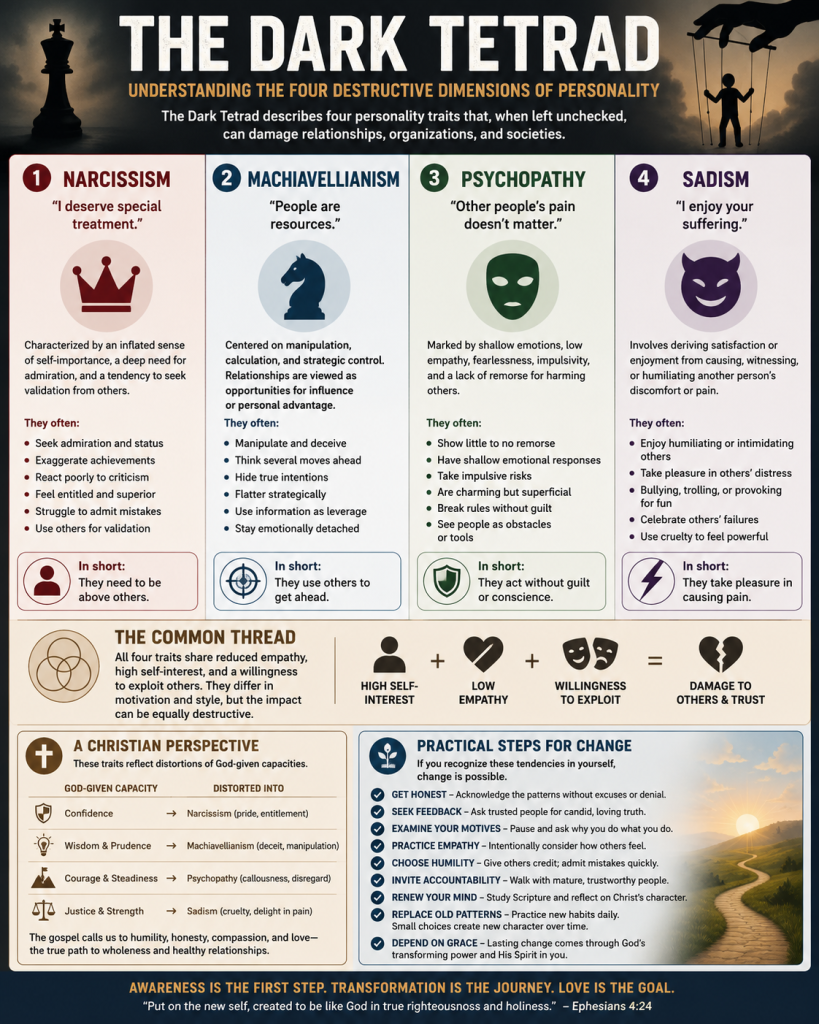
The Dark Tetrad: Understanding the Four Destructive Dimensions of Personality
Human beings possess an extraordinary capacity for love, creativity, sacrifice, and service. Yet history and everyday experience also remind us that we are capable of manipulation, exploitation, cruelty, and profound selfishness. Modern personality psychology has sought to understand these darker aspects of human nature through what is known as the Dark Tetrad: four personality traits that, when left unchecked, can damage relationships, organizations, and entire societies. While these traits exist along a spectrum and do not necessarily indicate a mental disorder, they offer valuable insight into patterns of thinking and behavior that can erode both character and trust.
The four traits that comprise the Dark Tetrad are narcissism, Machiavellianism, psychopathy, and sadism. Each reflects a different way that self-interest can become detached from empathy, humility, and moral responsibility. Most people exhibit these characteristics to some degree under certain circumstances, but individuals who consistently score high in these traits are more likely to manipulate, exploit, or harm others for personal gain.
Narcissism: The Need to Be Above Others
Narcissism is characterized by an inflated sense of self-importance, a deep need for admiration, and a tendency to seek validation from others. Narcissistic individuals often believe they deserve special treatment and may become defensive or hostile when their self-image is challenged. While healthy confidence is essential for personal growth, narcissism represents confidence distorted into entitlement. Relationships become less about mutual love and more about receiving affirmation, admiration, or status.
Narcissistic personalities often struggle to admit mistakes because doing so threatens the image they have carefully constructed. As a result, criticism may be met with denial, blame-shifting, or anger rather than humility and reflection.
Machiavellianism: Manipulation as a Strategy
Named after the Renaissance political writer Niccolò Machiavelli, Machiavellianism describes a personality style centered on manipulation, calculation, and strategic control. Individuals high in this trait tend to view relationships as opportunities to gain influence or advantage. They may flatter others, conceal their true intentions, exploit divisions, or carefully manage information to achieve desired outcomes.
Unlike narcissists, Machiavellian individuals do not necessarily seek admiration. Their primary goal is often power, control, or personal advantage. They are typically patient, emotionally detached, and highly strategic, making them difficult to recognize because they often appear charming, agreeable, or cooperative on the surface.
Psychopathy: The Absence of Remorse
Psychopathy is characterized by shallow emotional responses, low empathy, fearlessness, impulsivity, and a lack of remorse for harming others. Contrary to popular portrayals, most individuals with psychopathic traits are not violent criminals. Many function successfully in professional settings and may even excel in high-pressure environments because they remain calm during crises.
The defining feature of psychopathy is not aggression but emotional detachment. People become obstacles, tools, or opportunities rather than individuals worthy of compassion. Decisions are often guided by immediate gratification or personal gain with little consideration for the consequences experienced by others.
Sadism: Pleasure in Another’s Suffering
The fourth component of the Dark Tetrad distinguishes it from the earlier Dark Triad. Sadism involves deriving satisfaction or enjoyment from another person’s discomfort, humiliation, fear, or suffering. In modern psychology, researchers often refer to everyday sadism, which includes behaviors such as bullying, humiliating coworkers, provoking strangers online, enjoying public embarrassment, or deliberately intimidating others.
Unlike psychopathy, where another person’s suffering may simply be irrelevant, sadism involves actively taking pleasure in causing or observing that suffering. This tendency can appear in subtle social interactions just as easily as in more overt forms of abuse.
The Common Thread
Although each trait has unique characteristics, they share several important features. Individuals high in Dark Tetrad traits often exhibit reduced empathy, heightened self-interest, a willingness to exploit others, and difficulty maintaining authentic, reciprocal relationships. Trust becomes a tool rather than a virtue, and people become means to an end rather than individuals possessing inherent dignity.
It is important to remember that these traits exist on a continuum. Most people will occasionally recognize moments of pride, manipulation, emotional detachment, or even a desire to see an adversary embarrassed. The purpose of understanding the Dark Tetrad is not to label people as “good” or “evil,” but to recognize patterns that, if reinforced over time, can undermine character and damage relationships.
A Christian Perspective
From a Christian perspective, the Dark Tetrad can be understood as examples of disordered aspects of the human heart rather than separate categories of irredeemable people. Scripture consistently teaches that every person struggles with the corruption of sin and that the human heart is capable of both remarkable goodness and profound self-deception. Pride, deceit, hardness of heart, and cruelty are recurring themes throughout the Bible because they distort capacities that God originally created for good. Confidence becomes pride. Wisdom becomes manipulation. Courage becomes callousness. Justice becomes cruelty when divorced from mercy and love. The solution, therefore, is not simply behavior modification but the ongoing transformation of the heart through humility, repentance, and conformity to the character of Christ.
Recognizing and Changing These Tendencies
Perhaps the most encouraging aspect of the Dark Tetrad is that personality is not destiny. Self-awareness is the first step toward change. If you find yourself consistently seeking admiration, manipulating situations to gain control, dismissing the feelings of others, or taking satisfaction in another person’s failure or humiliation, resist the temptation to justify or hide those impulses. Instead, examine them honestly. Ask trusted friends, mentors, or family members for candid feedback. Learn to pause before reacting, especially when your pride is threatened or your desire for control is activated. Practice empathy by intentionally considering another person’s perspective and asking how your actions affect them. Confess areas of selfishness to God in prayer, invite accountability from mature believers, and deliberately cultivate the opposing virtues of humility, honesty, compassion, patience, and sacrificial love. Character is shaped by repeated choices. As we repeatedly choose truth over manipulation, service over self-exaltation, mercy over cruelty, and love over domination, our hearts are gradually reordered. Lasting transformation is rarely instantaneous, but with honest self-examination, intentional practice, supportive relationships, and God’s sanctifying work, even deeply rooted patterns can be changed.