
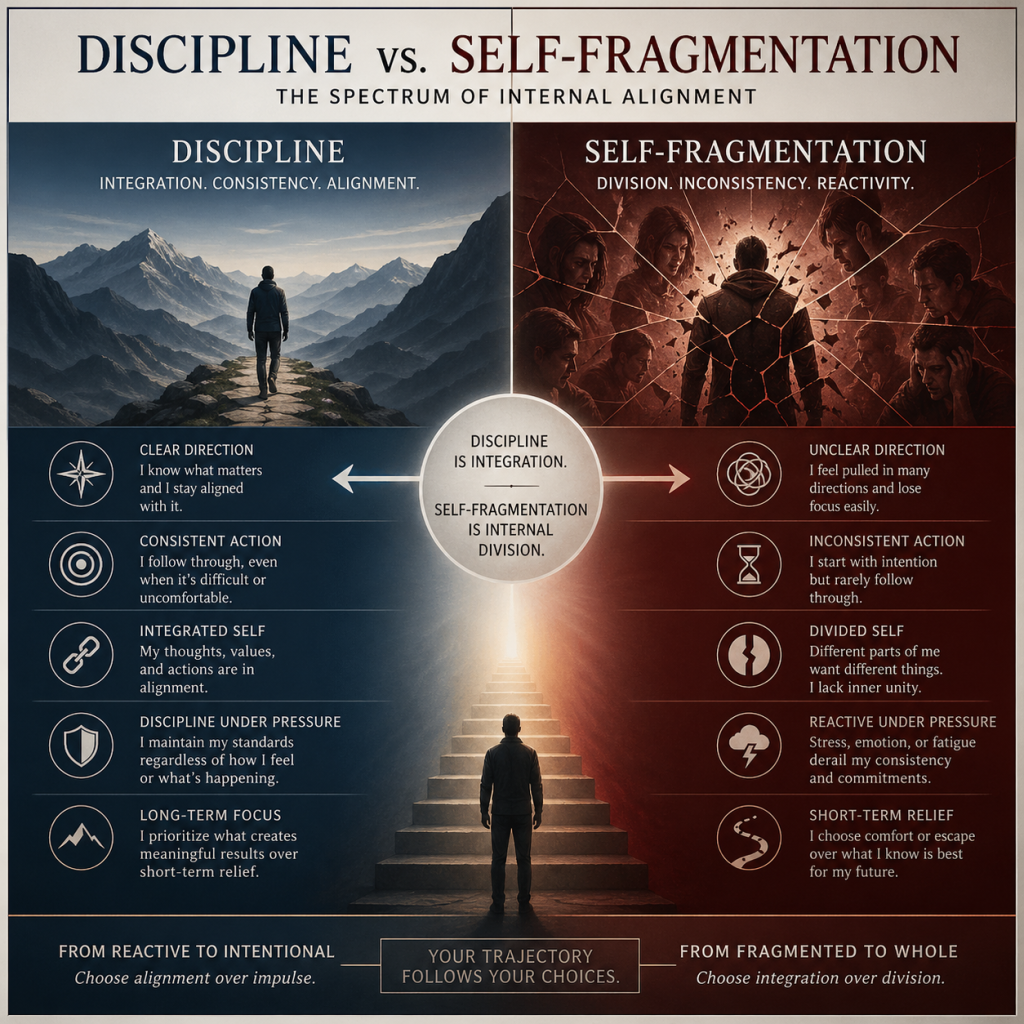
Discipline is often misunderstood as force, effort, or the ability to push through resistance. In reality, the deeper issue most people face is not a lack of effort, but a lack of internal alignment. Beneath inconsistency, procrastination, and broken follow-through lies something more fundamental: self fragmentation. This is the experience of being internally divided, where different parts of the self compete for control, each pulling toward a different outcome. The spectrum of Discipline versus Self Fragmentation is not about how hard a person works, but about whether they are operating as a unified whole or a divided system.
The first key point is that self fragmentation creates internal conflict that undermines consistency. A person may clearly know what matters, set meaningful goals, and even feel motivated at times, yet still fail to act in alignment with those intentions. This is because another part of them is simultaneously seeking comfort, avoidance, or short-term relief. These competing drives are not resolved, so behavior becomes inconsistent. One moment there is clarity and commitment, and the next there is hesitation or retreat. This leads to frustration and confusion, because the person experiences both sincerity and failure at the same time. Without recognizing this internal division, they often misinterpret the problem as laziness or lack of discipline, when in reality they are operating from a fragmented internal state.
The second point is that discipline, when properly understood, is the result of integration rather than force. It is not about overpowering resistance, but about aligning thought, value, and action into a coherent direction. When a person is internally aligned, they no longer rely on fluctuating motivation or ideal conditions to act. Their behavior becomes more stable because it is anchored in clarity rather than impulse. This does not eliminate difficulty, but it reduces internal friction. Instead of being pulled in multiple directions, the individual can move forward with steadiness. Over time, this builds trust within oneself. The person begins to experience that they can rely on their own actions, which reinforces further alignment and reduces the need for constant effort.
The third point is that awareness is the turning point between fragmentation and discipline. Most people are not consciously aware of the internal divisions driving their behavior. They experience the symptoms, such as inconsistency, distraction, or avoidance, without seeing the underlying structure. Growth begins when these patterns are brought into awareness. When a person can identify the competing impulses within them, they gain the ability to make intentional choices rather than reactive ones. This awareness allows them to begin the process of integration, choosing repeatedly to act in alignment with what they know to be true. Each of these choices strengthens internal coherence, gradually reducing fragmentation and increasing disciplined action.
In conclusion, the movement from self fragmentation to discipline is not a matter of trying harder, but of becoming more unified. Fragmentation leads to drift, inconsistency, and internal tension, while discipline emerges from alignment, clarity, and steady action. By developing awareness of internal conflict and intentionally aligning behavior with deeper values, a person transforms their approach to life. They move from reacting to competing impulses toward navigating with intention. In this shift, discipline is no longer experienced as force, but as the natural expression of an integrated self.