
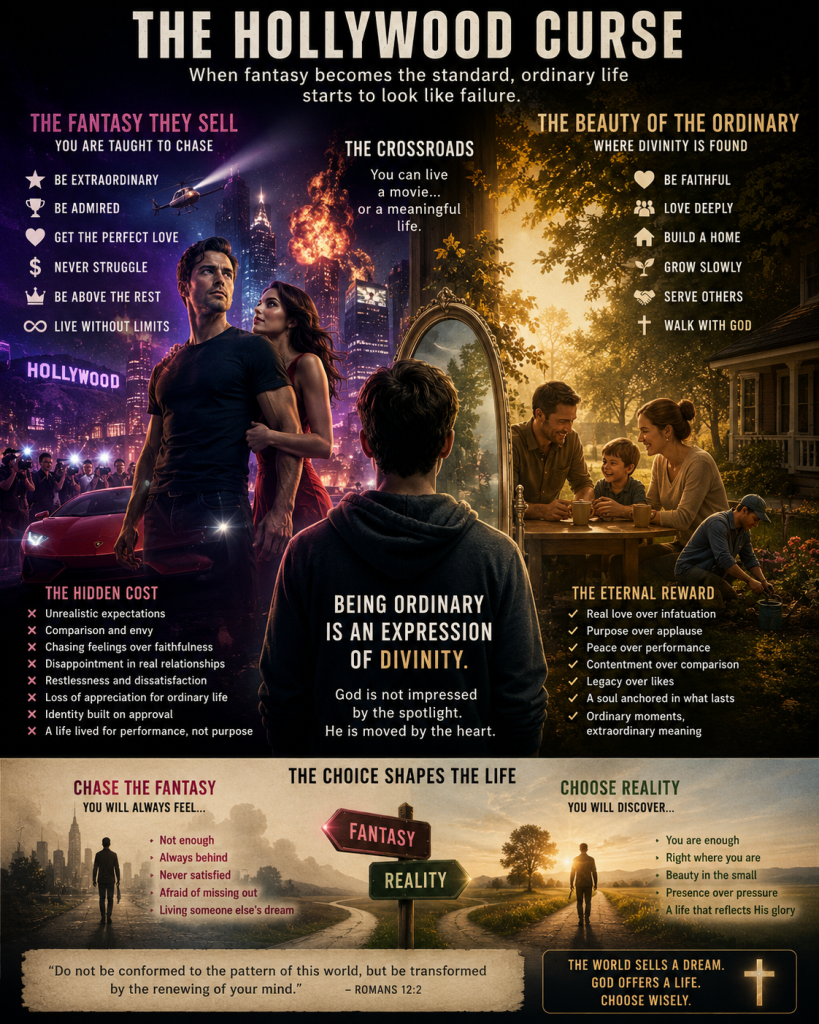
The Hollywood Curse
Human beings are storytelling creatures. Long before movies, people gathered around fires listening to myths, legends, and heroic tales. Stories shape desire. They shape identity. They shape what people believe life is supposed to be. In the modern world, Hollywood has become one of the most powerful storytelling machines in human history, projecting idealized visions of love, beauty, heroism, success, and meaning into the minds of billions of people.
The problem is not merely that these stories are fictional. The deeper problem is that impressionable people often absorb these fantasies before they have enough life experience to recognize the difference between symbolic storytelling and actual reality.
Young boys grow up watching action heroes who save the world through strength, charisma, violence, confidence, and exceptionalism. The hero defeats evil, earns admiration, and almost always receives the undying affection of a beautiful woman as a reward. Young girls grow up absorbing romantic fantasies centered on emotional intensity, idealized love, dramatic passion, perfect chemistry, and extraordinary devotion. Both are taught, often subconsciously, that ordinary life is not enough.
But ordinary life is where most of reality actually exists.
The curse of Hollywood is not simply unrealistic expectations. It is the gradual devaluation of ordinary existence itself. If the saying is true that “being ordinary is an expression of divinity,” then modern prosperous societies are in deep spiritual trouble because ordinary does not sell. Stability does not sell. Humility does not sell. Quiet devotion does not sell. Faithfulness does not sell. Raising children, loving one spouse for forty years, working honestly, caring for aging parents, building community, and living a peaceful life are rarely treated as glorious enough for the modern imagination.
The modern entertainment world survives by stimulating fantasy, intensity, novelty, envy, and desire. The extraordinary captures attention because human beings are instinctively drawn toward status, beauty, power, and idealism. The result is a culture where many people begin quietly despising the life directly in front of them.
The ordinary man begins to feel invisible because he is not extraordinary enough.
The ordinary woman begins to feel undesirable because she cannot compete with perfected fantasy.
The ordinary marriage begins to feel disappointing because it lacks cinematic intensity.
The ordinary life begins to feel like failure.
Yet many of the ideals being sold are deeply misleading. The action hero fantasy appears powerful, but real life often reveals a darker truth. The man who lives entirely for conquest, intensity, admiration, and external validation frequently struggles with loneliness, instability, emotional isolation, failed relationships, addiction, narcissism, or an inability to form deep intimacy. Constantly needing to be exceptional can become a prison. A man may save the world on screen while remaining incapable of loving one person consistently in reality.
The romantic fantasy is equally dangerous. Many people become attached not to real human beings, but to idealized emotional experiences. They search endlessly for “the one” who will complete them, heal them, validate them, and remove all loneliness and insecurity. Relationships become less about mutual sacrifice and devotion and more about emotional intoxication. When ordinary human flaws appear, disappointment follows because reality cannot sustain fantasy forever.
Hollywood often teaches people to worship intensity rather than intimacy.
Intensity is dramatic.
Intimacy is ordinary.
Intensity is obsession, fantasy, adrenaline, chemistry, pursuit, and emotional extremes.
Intimacy is patience, forgiveness, honesty, consistency, sacrifice, vulnerability, and shared suffering over time.
One creates stimulation.
The other creates love.
This helps explain why prosperous societies can become spiritually disoriented. Material abundance gives people enough comfort and leisure to endlessly chase self actualization, fantasy, identity, excitement, and idealized experience. In poorer or harsher conditions, survival itself grounds people in reality. But in prosperous societies, the imagination can become untethered from ordinary life. People begin comparing themselves not to neighbors or family, but to carefully crafted illusions projected through screens or intellectual theory.
And yet divinity may be hiding precisely where modern culture least wants to look.
Perhaps God is found more in quiet faithfulness than public greatness.
Perhaps holiness looks less like cinematic perfection and more like enduring love.
Perhaps the greatest heroes are not those who conquer nations, but those who conquer themselves.
The mother quietly raising children with patience and tenderness.
The husband remaining faithful when life becomes difficult.
The worker showing integrity when nobody notices.
The friend who stays.
The person who forgives.
The recovering addict learning honesty one painful day at a time.
The lonely person resisting bitterness.
The ordinary life lived truthfully may actually contain far more spiritual beauty than the fantasies people spend their lives chasing.
Christ Himself came in almost complete opposition to worldly idealization. Scripture says there was nothing outwardly impressive about Him that people should desire Him. He was not born into luxury, status, beauty, or political power. He washed feet. He suffered quietly. He loved ordinary people. He spent time with fishermen, laborers, prostitutes, tax collectors, and the broken. The kingdom He described was built on humility, service, sacrifice, forgiveness, and love rather than spectacle.
Modern culture trains people to seek glory through being exceptional.
Christianity points toward glory through surrender.
Hollywood says your life matters when the world notices you.
Christ says your life matters because God sees you already.
And perhaps that is the deepest curse of idealized fantasy: it blinds people to the sacredness of the life already in front of them. It teaches them to hunger endlessly for some future perfect existence while overlooking the quiet divinity hidden inside ordinary love, ordinary suffering, ordinary work, and ordinary human connection.
The tragedy is not that people dream.
The tragedy is that many never learn how beautiful reality can become once they stop demanding it resemble a movie.