
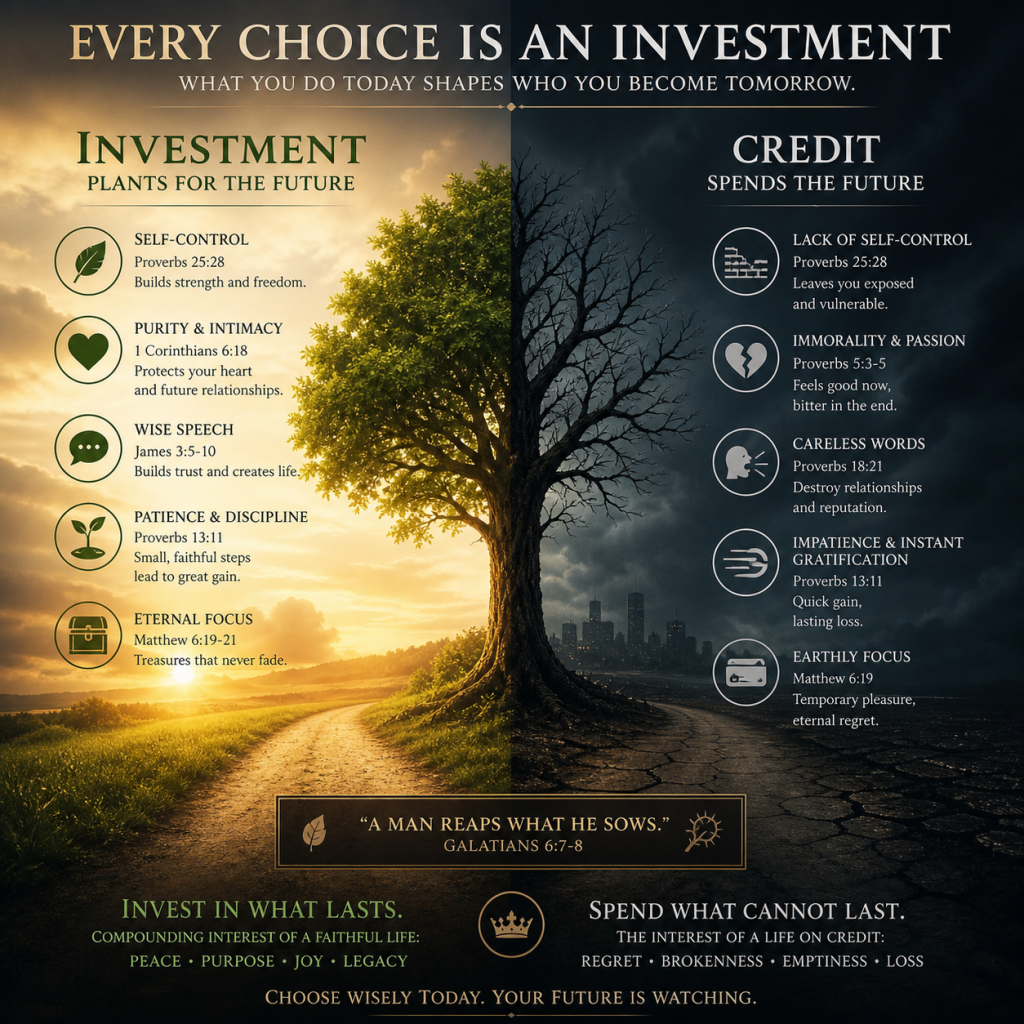
The Biblical narrative mirrors real human patterns. One that is most central to both is that human life operates on a moral economy. Not in the shallow sense of reward and punishment, but in the deeper sense of investment versus consumption. Scripture consistently frames our choices as either planting seeds that grow over time or spending something that cannot be recovered. It is less about restriction and more about trajectory.
The Bible often speaks in agricultural language because it captures this reality with precision. In Galatians 6:7–8, we are told, “A man reaps what he sows.” This is not a threat, it is a law. Every action, every habit, every pattern of speech and desire is a seed. Some seeds grow slowly, beneath the surface, but they are no less real. Others produce immediate sensation but leave the soil depleted. The distinction is not always visible in the moment, which is why discipline and faith are required.
Sexuality is one of the clearest examples of this principle. In the biblical vision, sex is not merely physical. It is deeply unitive, binding two people together at the level of identity and vulnerability. In 1 Corinthians 6:18, Paul warns that sexual immorality is unique because it is a sin “against one’s own body.” This is not framed as moralism for its own sake, but as insight into how profoundly costly misused intimacy can be. When sex is detached from commitment, from covenant, from emotional and spiritual union, it becomes a kind of borrowing against the future.
It feels like gain in the present. But it often fragments the heart, conditions attachment to intensity over intimacy, and trains the mind toward short term gratification. What is spent cannot be reinvested. The capacity for depth, trust, and long term connection is quietly eroded. This is why Proverbs speaks so frequently about the “forbidden woman” not just as a moral warning, but as a metaphor for all forms of seductive short term gain. “In the end she is bitter as wormwood”(Proverbs 5:4). The warning is about trajectory, not just behavior.
This pattern extends far beyond sexuality. It governs speech, thought, money, relationships, and leadership. In James 3, the tongue is described as a small spark that can set an entire forest on fire. Words are not neutral. They are investments. They either build trust, clarity, and unity over time, or they create fractures that compound into division and isolation. A careless word may feel insignificant in the moment, but it plants something that grows.
Likewise, in Proverbs 13:11, we read, “Wealth gained hastily will dwindle, but whoever gathers little by little will increase it.” This is the same principle. The slow path, the disciplined path, the patient accumulation of small right actions leads to compounding growth. The fast path, the impulsive path, the attempt to shortcut reality, leads to loss. The modern world often markets the fast path as freedom, but Scripture consistently reveals it as a form of hidden debt.
Jesus Himself frames life in these terms when He says in Matthew 6:19–21, “Do not store up for yourselves treasures on earth… but store up for yourselves treasures in heaven… For where your treasure is, there your heart will be also.” The heart follows investment. Whatever we continually give ourselves to, we become bound to. This is why the issue is not merely what we do, but what we attach to.
The metaphor of credit versus investment becomes especially powerful here. Living for immediate gratification is like living on credit. It gives the illusion of abundance now, but it quietly accumulates a cost that must be paid later. Emotional instability, fractured relationships, loss of trust, and diminished capacity for meaning are often the interest payments. By contrast, disciplined living, restraint, and alignment with truth feel costly in the moment. They require sacrifice. But they function like investment. Over time, they produce stability, depth, clarity, and peace.
This is why the Bible so often emphasizes self control not as repression, but as wisdom. In Proverbs 25:28, “A person without self-control is like a city with broken-down walls.” Without boundaries, without restraint, a person becomes vulnerable to every impulse and influence. Nothing is protected. Nothing is preserved. There is no place for growth because everything is constantly being consumed.
To transcend instinct, especially in areas like sexuality, is not to deny human nature but to refine it. It is to move from being driven by appetite to being guided by purpose. The biblical vision is not anti desire. It is anti fragmentation. It seeks to unify the person so that desire, action, and identity are aligned toward something that endures.
Ultimately, the question Scripture forces us to confront is this: Are you building something that will last, or are you spending what cannot be recovered? Every choice answers that question. Every day we either invest into a future we cannot yet see, or we consume that future for the sake of the present.
The wisdom of the Bible is not merely that certain behaviors are right or wrong. It is that reality itself is structured in such a way that truth compounds and deception collapses. The person who learns to live as an investor of the soul, rather than a consumer of the moment, begins to experience a different kind of life. One marked not by fleeting intensity, but by enduring substance.