
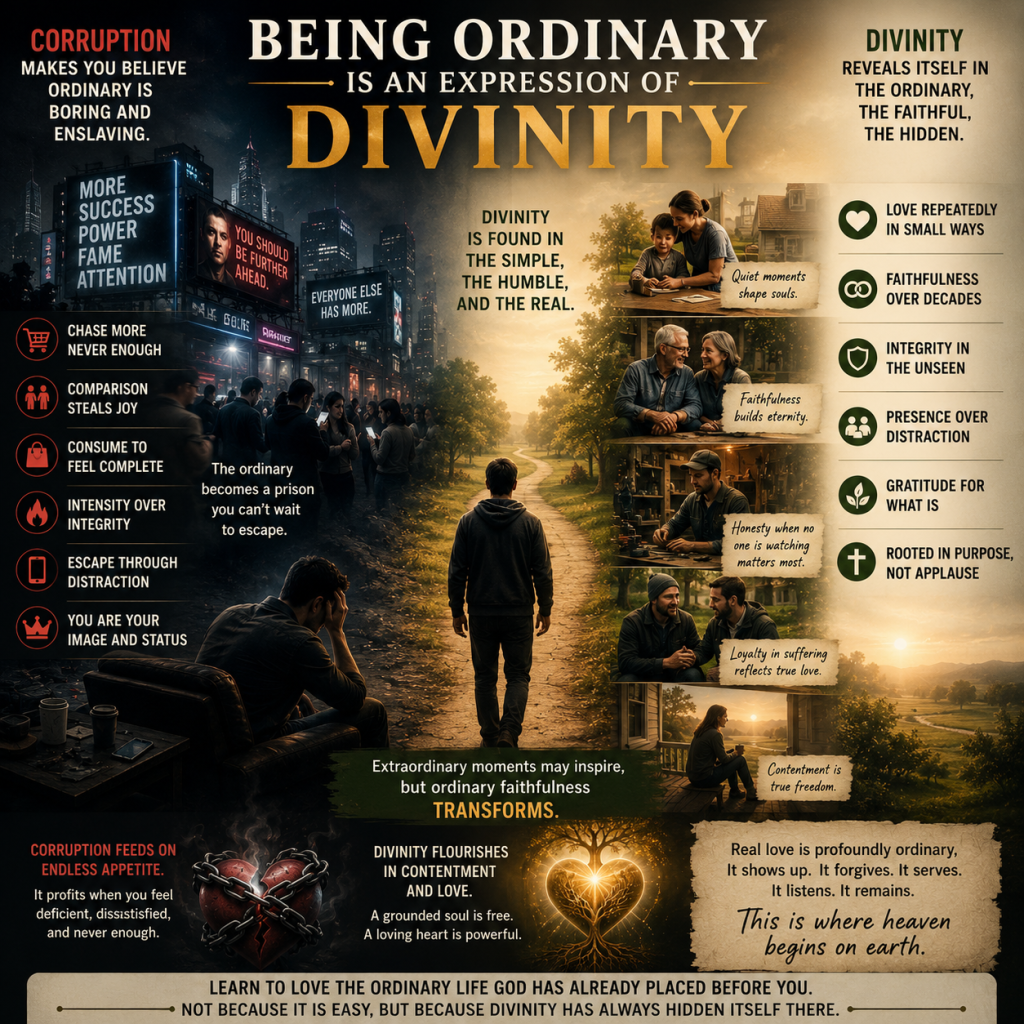
Modern culture has become deeply suspicious of ordinary life. To be ordinary is often framed as failure. Average means invisible. Stable means boring. Routine means lifeless. Quiet faithfulness is interpreted as a lack of ambition. Many people now grow up absorbing the belief that significance only exists through exceptionalism, influence, wealth, beauty, fame, intensity, or constant self reinvention. But perhaps this entire framework is backwards. Perhaps being ordinary is not evidence of insignificance at all. Perhaps it is one of the deepest expressions of divinity available to human beings.
The corruption of modern culture works by teaching people to despise the life directly in front of them. It whispers constantly that fulfillment exists somewhere else: another relationship, another identity, another achievement, another emotional high, another experience, another level of status. The ordinary becomes framed as a prison from which the self must escape. Yet this endless pursuit often creates exactly the opposite of freedom. It produces restlessness, envy, addiction, instability, comparison, narcissism, and chronic dissatisfaction. A person becomes psychologically incapable of resting inside the life they already have. They become trapped in perpetual hunger for novelty and intensity because corruption survives by severing people from contentment.
This is why modern systems constantly stimulate dissatisfaction. Advertising tells people they are incomplete without consumption. Entertainment tells people ordinary love is not enough. Social media tells people ordinary appearance is not enough. Politics tells people ordinary citizenship is not enough. Consumer culture tells people ordinary existence itself is inadequate. But divinity often reveals itself in exactly the places corruption teaches people to overlook.
The parent quietly caring for a child. The husband remaining faithful for decades. The woman showing kindness no one notices. The worker doing honest labor with integrity. The friend who remains loyal during suffering. The recovering addict learning discipline one painful day at a time. The elderly couple still holding hands. None of these would likely become blockbuster movies, yet they may contain more genuine spiritual beauty than the fantasies dominating the modern imagination.
Corruption hates ordinary life because ordinary life slows people down enough to confront themselves. Silence reveals inner emptiness. Stability reveals unresolved restlessness. Faithfulness exposes the addicted hunger for novelty and validation. Ordinary life forces people to wrestle with who they are without spectacle. This is one reason distraction has become almost sacred in modern society. Noise protects people from self confrontation. Constant stimulation protects people from stillness. Fantasy protects people from reality. But God is often found in stillness.
Scripture repeatedly reveals this pattern. God was not found in the earthquake, the fire, or the violent wind, but in the still small voice. Christ Himself entered the world not as a conquering emperor surrounded by spectacle, but as the son of a carpenter born into obscurity. He spent most of His earthly life in ordinary existence. He walked among laborers, fishermen, mothers, the poor, the sick, and social outcasts. He washed feet. He cooked meals. He touched wounds. He lived slowly enough to truly see people.
Modern culture worships visibility, but divinity often works quietly. Corruption tells people they must become extraordinary to matter. But this creates a civilization full of people desperately performing identities while secretly feeling unseen and unloved. Everyone attempts to become exceptional, yet many lose the ability to simply become human. The obsession with exceptionalism frequently masks a deeper spiritual wound: the inability to accept oneself without external validation. A person begins believing they must constantly prove their worth through beauty, achievement, influence, ideology, productivity, intelligence, or attention. The ordinary self becomes intolerable.
But the inability to tolerate ordinary life is often the inability to tolerate reality itself. Reality contains repetition, routine, limitations, aging, responsibility, patience, commitment, slow growth, maintenance, and human weakness. Yet these are precisely the environments where many of the highest virtues are formed: humility, discipline, compassion, loyalty, gratitude, forgiveness, endurance, and love. Extraordinary moments may inspire people briefly, but ordinary life forms character.
Corruption frames ordinary life as enslaving because corruption depends upon appetite without end. A content and grounded person is difficult to manipulate. Someone capable of gratitude, stability, humility, and inner peace consumes less compulsively. They compare themselves less. They chase status less. They become less vulnerable to systems built on envy, fear, insecurity, and emotional stimulation. This is why so much of modern culture profits from making people feel deficient. If ordinary life is sacred, much of consumer civilization loses its psychological power.
Perhaps this is one of the great spiritual revelations hidden in plain sight: human beings were never designed to endlessly worship intensity. They were designed to learn how to love. Real love is profoundly ordinary. Not because it lacks beauty, but because it exists in repetition. Showing up repeatedly. Forgiving repeatedly. Serving repeatedly. Listening repeatedly. Remaining repeatedly. The world calls this boring because corruption only recognizes stimulation. But love recognizes meaning where corruption sees monotony.
Perhaps heaven itself is not endless novelty, but endless wholeness. And perhaps one of the greatest acts of spiritual rebellion in the modern world is learning how to quietly love the ordinary life God has already placed directly in front of you. Not because ordinary life is easy, but because divinity has always hidden itself inside the simple, the humble, and the real.