
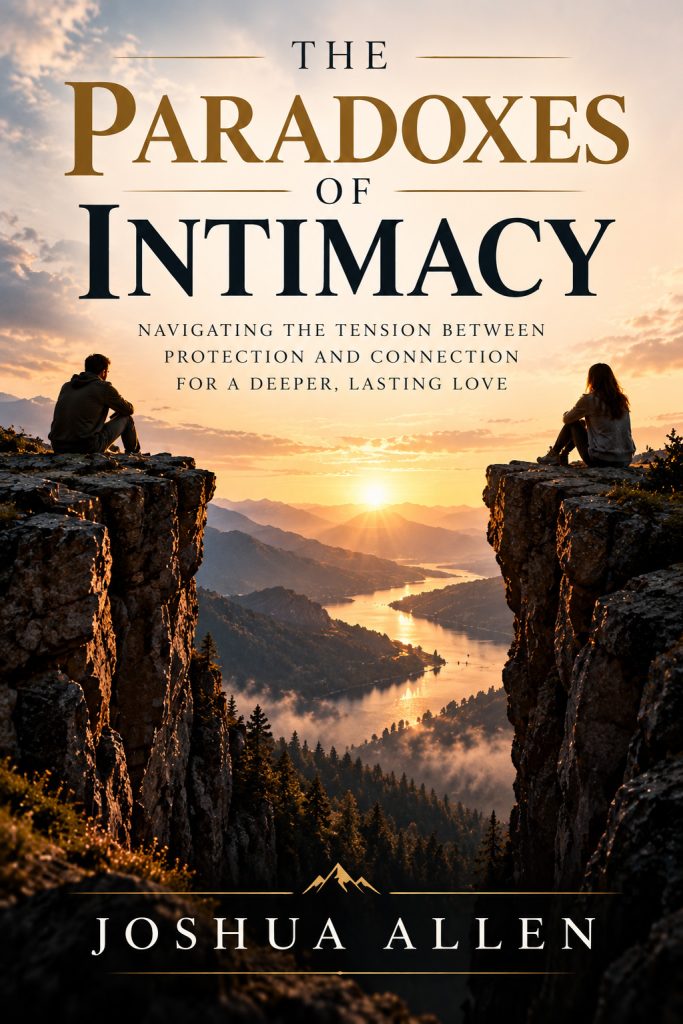
THE PARADOXES OF INTIMACY
Navigating the Tension Between Protection and Connection for a Deeper, Lasting Love
By Joshua Allen
Why does the person who makes us feel safest also have the greatest power to hurt us?
There is a particular kind of courage in loving after you have loved and lost. Before loss, we may enter love without fully understanding what is at stake. After loss, we know. We know how deeply another person can become woven into our lives, how painful their absence can become, and how excruciating it can be when something we believed would last comes to an end.
To know all of this and still voluntarily open the heart again, to allow another person to matter, to become vulnerable, and to risk grief so that another human being might experience being deeply loved, is one of the great acts of love. It is no longer love born from the illusion that nothing will go wrong. It is love with open eyes: “I know what this could cost me, and I choose to love you anyway.”
THE CLOSER WE BECOME, THE MORE WE HAVE TO LOSE
Intimacy creates one of the great contradictions of human life. The person who becomes capable of providing our greatest sense of comfort, belonging, acceptance, and love also becomes capable of reaching the places within us that are most vulnerable to pain.
This is why relationships can feel simultaneously like coming home and walking onto dangerous ground.
As another person becomes more important to us, our capacity for love increases, but so does our capacity to be hurt. Old wounds awaken. Defenses emerge. Fear can masquerade as discernment. Control can masquerade as security. Independence can masquerade as strength.
And sometimes the very strategies we use to protect ourselves from losing love make it more difficult to experience it.
THE PARADOXES OF INTIMACY
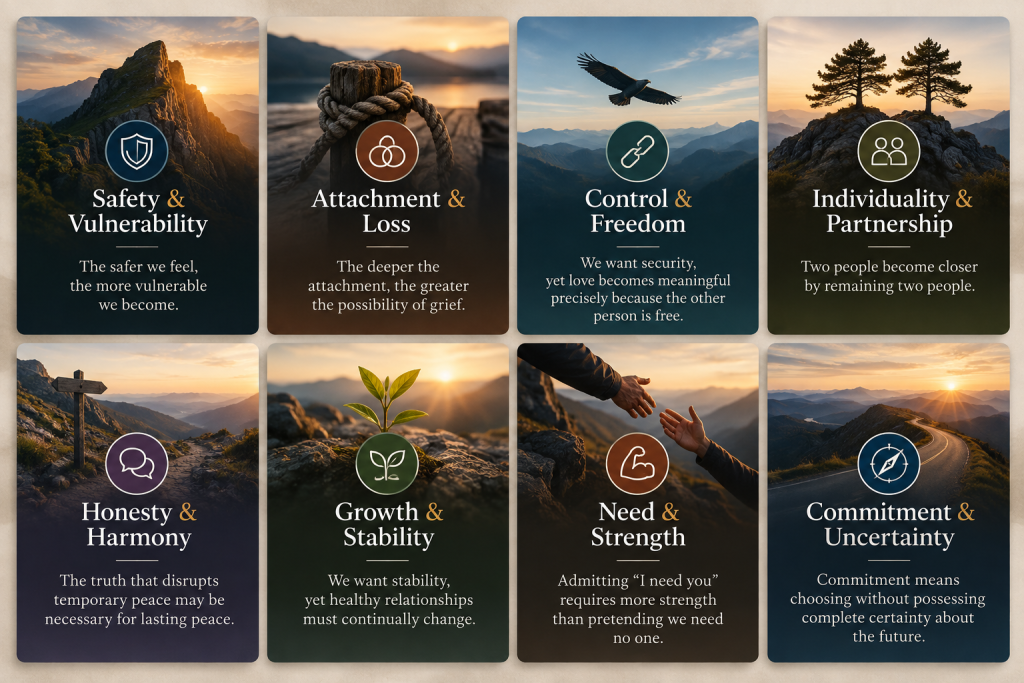
The Paradoxes of Intimacy explores 35 contradictions that emerge as two people attempt to build a deep and lasting relationship.
Safety & Vulnerability
The safer we feel, the more vulnerable we become. To experience the security we desire, we eventually have to lower some of the defenses we created to protect ourselves.
Attachment & Loss
The deeper the attachment, the greater the possibility of grief. We cannot deeply love another person without becoming capable of deeply missing them.
Control & Freedom
We want reassurance that the person we love will stay, yet love becomes meaningful precisely because they remain free. We cannot possess another person’s freedom and simultaneously receive the gift of being freely chosen.
Individuality & Partnership
Two people become closer by remaining two people. Healthy intimacy creates an “us” without requiring either person to surrender the “I.”
Honesty & Harmony
The truth that temporarily disrupts peace may be necessary for lasting peace. Sometimes the difficult conversation we fear will damage the relationship is precisely the conversation intimacy requires.
Growth & Stability
We want relationships to feel stable, yet healthy relationships must continually change. Lasting love requires learning to love not only who someone is today, but who they are becoming.
Need & Strength
Healthy independence includes the capacity to depend on another person. Sometimes admitting “I need you” requires more strength than pretending we need no one.
Commitment & Uncertainty
Commitment means choosing without possessing complete certainty about the future. We cannot know the entire road before taking it; eventually, love asks us to discern carefully and then choose.
LOVE AWAKENS MORE THAN LOVE
Intimacy does not merely reveal the person we love. It reveals us.
Relationships expose our fears, expectations, attachment patterns, defenses, wounds, needs, boundaries, desires, and beliefs about ourselves. The deeper another person enters our inner world, the more they encounter parts of us that may have remained hidden even from ourselves.
This is why intimacy can become one of life’s most powerful environments for self-knowledge.
We enter a relationship hoping to discover another person and eventually discover ourselves.
FROM AN ARMORED HEART TO A DISCERNING HEART
The answer is not to become completely unguarded.
It is also not to build a fortress around the heart.
Healthy intimacy requires something more difficult: discernment.
Discernment allows us to remain open without becoming indiscriminate. To trust without becoming blind. To establish boundaries without building walls. To listen to fear without automatically obeying it. To allow another person to matter without abandoning ourselves.
The goal is not to become impossible to hurt.
The goal is to become capable of loving wisely.
35 PARADOXES. 8 DIMENSIONS OF INTIMACY. ONE CENTRAL QUESTION.
How do we open ourselves deeply enough to experience real love without abandoning the wisdom necessary to protect what is most valuable within us?
The Paradoxes of Intimacy is written for the single person preparing for a healthier relationship, the new couple trying to build a strong foundation, and the long-term couple seeking a deeper level of connection.
Each chapter concludes with reflection questions designed to help you move beyond simply understanding the ideas and begin examining how they appear within your own relationships.
Read it individually.
Share it with someone you are learning to love.
Work through it together.
Return to it when intimacy reaches a new depth and reveals something neither of you expected to find.
THE PARADOXES ARE NOT THE PROBLEM
Love will always contain vulnerability.
Attachment will always contain the possibility of loss.
Freedom will always contain uncertainty.
Honesty will sometimes disturb the peace.
Growth will sometimes disrupt stability.
Need will expose vulnerability.
Commitment will never reveal the entire future.
The goal is not to eliminate these tensions.
The paradoxes of intimacy are not problems to be solved. They are tensions we become strong enough to hold.
THE PARADOXES OF INTIMACY
Joshua Allen
Navigating the Tension Between Protection and Connection for a Deeper, Lasting Love