
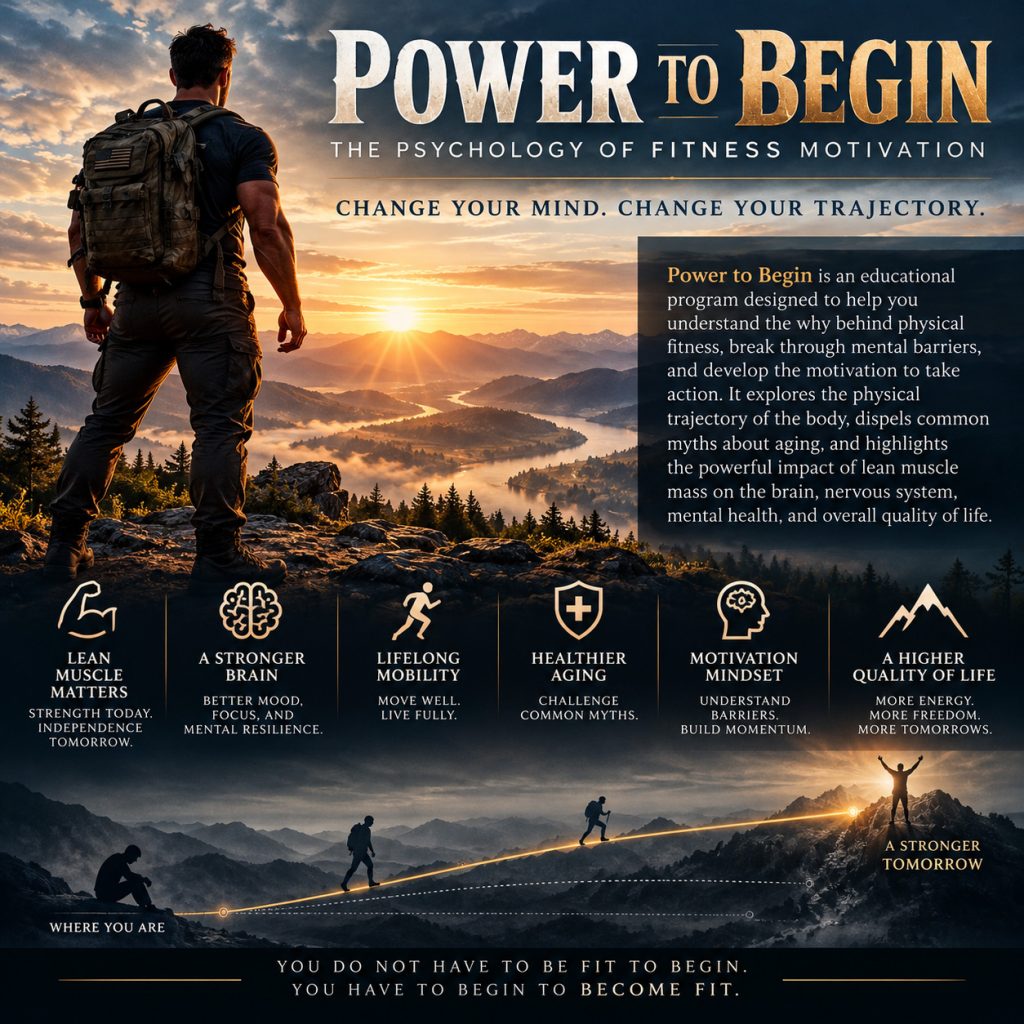
Power to Begin: Physical Health Trajectory Assessment
The Psychology of Fitness Motivation
Your current physical condition is not your destiny. Your trajectory matters more than your starting point.
Purpose
This assessment is designed to help you evaluate your current physical health trajectory by examining the habits, behaviors, attitudes, and lifestyle choices that influence long-term strength, mobility, independence, and quality of life.
The central question is not simply, How healthy am I today? It is:
If I continue living exactly as I am today, what is my physical condition likely to look like 10, 20, or 30 years from now?
Your age, medical history, genetics, and current physical limitations all influence your health. However, your daily choices can also significantly affect your future physical functioning.
The objective is to identify where you are today, recognize the direction you are heading, and discover opportunities to improve your trajectory.
Instructions
Consider your typical habits and behaviors over the past 30–90 days.
For each statement, assign yourself a score:
0 — Rarely or Never: This statement generally does not describe me.
1 — Sometimes or Partially: This statement describes me inconsistently.
2 — Consistently: This statement accurately describes my regular habits, attitudes, or abilities.
Record your score beside each statement. Answer according to your actual circumstances rather than your intentions.
This is an educational self-assessment, not a validated medical risk calculator. It cannot diagnose illness, determine biological age, or predict lifespan.
Section 1: Physical Activity & Daily Movement
Evaluating your current level of movement and cardiovascular activity.
I accumulate at least 150 minutes of moderate physical activity, or an equivalent amount of vigorous activity, each week. Score: ____
I regularly walk, climb stairs, or otherwise move throughout the day rather than remaining seated for extended periods. Score: ____
I can complete ordinary daily activities without excessive breathlessness or fatigue. Score: ____
I intentionally participate in activities that elevate my heart rate and challenge my cardiovascular endurance. Score: ____
My physical activity is consistent throughout most weeks rather than occurring in occasional bursts. Score: ____
Section 1 Total: ____ / 10
Section 2: Muscular Strength & Lean Muscle Mass
Evaluating your investment in strength, muscle preservation, and long-term physical independence.
I perform resistance training or muscle-strengthening activities at least twice per week. Score: ____
My exercise routine challenges major muscle groups, with adjustments for my physical abilities and limitations. Score: ____
I can rise from a chair, carry everyday objects, and perform essential strength-related activities with reasonable ease. Score: ____
I intentionally work to preserve or improve my muscular strength as I age. Score: ____
I understand the importance of lean muscle mass for metabolic health, physical functioning, and independence—not merely physical appearance. Score: ____
Section 2 Total: ____ / 10
Section 3: Mobility, Balance & Functional Fitness
Evaluating your ability to move safely, comfortably, and independently.
I can bend, reach, turn, and move through the ranges of motion necessary for my daily activities. Score: ____
I regularly participate in activities that maintain or improve flexibility, balance, mobility, or coordination. Score: ____
I can safely navigate ordinary physical environments, including stairs or uneven surfaces, using appropriate assistance when needed. Score: ____
I take recurring stiffness, pain, or movement limitations seriously and seek appropriate ways to address them. Score: ____
I intentionally work to preserve or improve my ability to perform daily tasks independently. Score: ____
Section 3 Total: ____ / 10
Section 4: Nutrition & Body Composition
Evaluating whether your dietary habits support long-term health, muscular strength, and physical functioning.
My regular diet includes a variety of nutrient-dense foods, including vegetables, fruits, and other minimally processed foods. Score: ____
I consume adequate protein to support my individual health needs, activity level, and muscular maintenance. Score: ____
I generally manage my food portions and overall energy intake in a manner consistent with my health goals. Score: ____
I limit excessive reliance on highly processed, low-nutrient foods and sugar-sweetened beverages. Score: ____
I approach nutrition through sustainable habits rather than repeatedly relying on extreme diets or temporary solutions. Score: ____
Section 4 Total: ____ / 10
Section 5: Sleep, Recovery & Lifestyle
Evaluating the habits that support physical recovery, nervous system functioning, and sustainable health.
I regularly obtain sufficient sleep to feel rested and function effectively, generally 7–9 hours for most adults. Score: ____
I maintain reasonably consistent sleeping and waking routines. Score: ____
I allow appropriate recovery between demanding physical activities. Score: ____
I use constructive methods to manage stress rather than routinely relying on unhealthy coping behaviors. Score: ____
I avoid tobacco and nicotine and keep alcohol consumption within health-protective limits, preferably none. Score: ____
Section 5 Total: ____ / 10
Section 6: Preventive Health & Personal Responsibility
Evaluating your willingness to understand, monitor, and actively manage your physical health.
I receive age-appropriate preventive healthcare and recommended medical screenings. Score: ____
I understand and monitor important indicators of my health, such as blood pressure, cholesterol, and blood glucose when appropriate. Score: ____
I actively manage known medical conditions and follow treatment recommendations developed with qualified healthcare professionals. Score: ____
I seek appropriate professional guidance when persistent symptoms, injuries, or physical limitations require evaluation. Score: ____
I take personal responsibility for learning about my health rather than waiting for serious problems to develop. Score: ____
Section 6 Total: ____ / 10
Section 7: Fitness Motivation & Psychological Barriers
Evaluating the beliefs, attitudes, and psychological patterns that influence your willingness to pursue physical fitness.
I believe meaningful physical improvement is possible for me regardless of my current age or fitness level. Score: ____
I am willing to begin with small, manageable activities rather than waiting for ideal circumstances. Score: ____
I understand that motivation often develops through action rather than always preceding it. Score: ____
I can experience temporary setbacks without abandoning my larger physical health goals. Score: ____
I view physical fitness as a lifelong investment rather than something motivated primarily by physical appearance. Score: ____
Section 7 Total: ____ / 10
Section 8: Future Orientation & Physical Trajectory
Evaluating your awareness of aging, physical decline, and the long-term consequences of your present habits.
I have a clear vision of the physical abilities and quality of life I would like to maintain over the next 10–20 years. Score: ____
I understand that inactivity and loss of muscular strength can contribute to avoidable physical decline as I age. Score: ____
My current habits generally support the physical future I envision for myself. Score: ____
I am willing to adjust my routines, priorities, and environment to protect my long-term physical health. Score: ____
I regularly evaluate my physical progress and make adjustments when my current approach is not producing meaningful improvement. Score: ____
Section 8 Total: ____ / 10
Physical Health Trajectory Score
Step 1: Record Your Age
Current Age: ______
Age provides important context for interpreting your physical condition, but it does not automatically reduce your score. A physically active 70-year-old may have healthier habits and better functional capacity than a sedentary 35-year-old.
Step 2: Calculate Your Score
Assessment Domain | Score |
|---|---|
1. Physical Activity & Daily Movement | ____ / 10 |
2. Muscular Strength & Lean Muscle Mass | ____ / 10 |
3. Mobility, Balance & Functional Fitness | ____ / 10 |
4. Nutrition & Body Composition | ____ / 10 |
5. Sleep, Recovery & Lifestyle | ____ / 10 |
6. Preventive Health & Personal Responsibility | ____ / 10 |
7. Fitness Motivation & Psychological Barriers | ____ / 10 |
8. Future Orientation & Physical Trajectory | ____ / 10 |
TOTAL | ____ / 80 |
Final Trajectory Score = Total Score × 1.25
My Physical Health Trajectory Score: ______ / 100
Step 3: Interpret Your Results
85–100: Strong Forward Trajectory
Your current habits demonstrate a strong commitment to physical health, muscular maintenance, functional independence, and long-term well-being. You are actively investing in the physical capabilities you hope to preserve throughout your life. Continue strengthening your foundation and addressing areas where improvement remains possible.
70–84: Positive Trajectory
You have established several healthy habits that support your long-term physical functioning. However, certain areas may be inconsistent or underdeveloped. With additional structure and attention, you have opportunities to improve your trajectory and reduce avoidable physical decline.
50–69: Uncertain Trajectory
Your lifestyle contains a mixture of protective habits and potentially harmful patterns. While some of your choices support physical health, others may gradually undermine strength, mobility, cardiovascular fitness, or metabolic health. Your future trajectory could improve substantially through more intentional daily action.
30–49: Concerning Trajectory
Several aspects of your current lifestyle may be working against your long-term physical health. Inactivity, inadequate muscular conditioning, inconsistent nutrition, poor recovery, or psychological barriers may be contributing to a pattern of avoidable decline. This is an opportunity for meaningful reorientation. Begin with realistic, sustainable changes rather than attempting to transform everything immediately.
0–29: High-Priority Reorientation
Your responses suggest that many important areas of physical health and personal health management are receiving insufficient attention. Continuing the same habits may increase the likelihood of preventable functional limitations or other health difficulties. The important message is not that your future is predetermined, but that meaningful changes deserve priority. Begin with manageable actions and seek individualized guidance where necessary.
Important: These scoring categories are educational and have not been clinically validated. They should not be interpreted as medical diagnoses, estimates of life expectancy, or precise predictions of future health.
Personal Trajectory Reflection
1. Your Current Direction
If you continue your present habits for the next 10 years, what do you realistically believe your physical condition, strength, mobility, and quality of life will look like?
Reflection:
2. Your Greatest Vulnerability
Which of the eight assessment domains received your lowest score? Why has this area received insufficient attention?
Reflection:
3. Your Beliefs About Aging
What physical limitations have you assumed are inevitable consequences of aging? Are these assumptions based on evidence, personal experience, or observations of other people?
Reflection:
4. Your Psychological Barriers
What most frequently prevents you from exercising, improving your nutrition, or taking better care of your physical health? Is it a lack of knowledge, motivation, confidence, time, energy, or something else?
Reflection:
5. Your Future Physical Self
Imagine yourself 20 years older. What would you like to remain physically capable of doing? Consider walking, traveling, recreation, independence, relationships, hobbies, and ordinary daily activities.
Reflection:
6. The Power to Begin
What is one realistic action you could begin taking immediately that would improve your physical trajectory if practiced consistently over the next year?
My Commitment:
Your Trajectory Can Change
The purpose of this assessment is not to compare your body with someone else’s or to measure your worth according to physical performance.
It is to recognize that the physical condition you experience in the future is influenced by the habits you practice today.
Aging is inevitable, but the rate and degree of physical decline vary considerably. Muscular strength, cardiovascular conditioning, mobility, balance, and metabolic health can often be improved through appropriate activity and lifestyle changes, even later in life.
You cannot control every aspect of your physical future. Genetics, illness, injury, disability, and circumstances beyond your control all play a role. Nevertheless, most individuals possess meaningful opportunities to improve their physical functioning and quality of life.
You do not need to become an athlete. You do not need an extraordinary physique. You do not need to transform your life overnight.
You need to understand where you are, decide where you want to go, and begin making choices that move you in that direction.
You do not have to be fit to begin. You have to begin to become fit.
Power to Begin — Change Your Mind. Change Your Trajectory.