
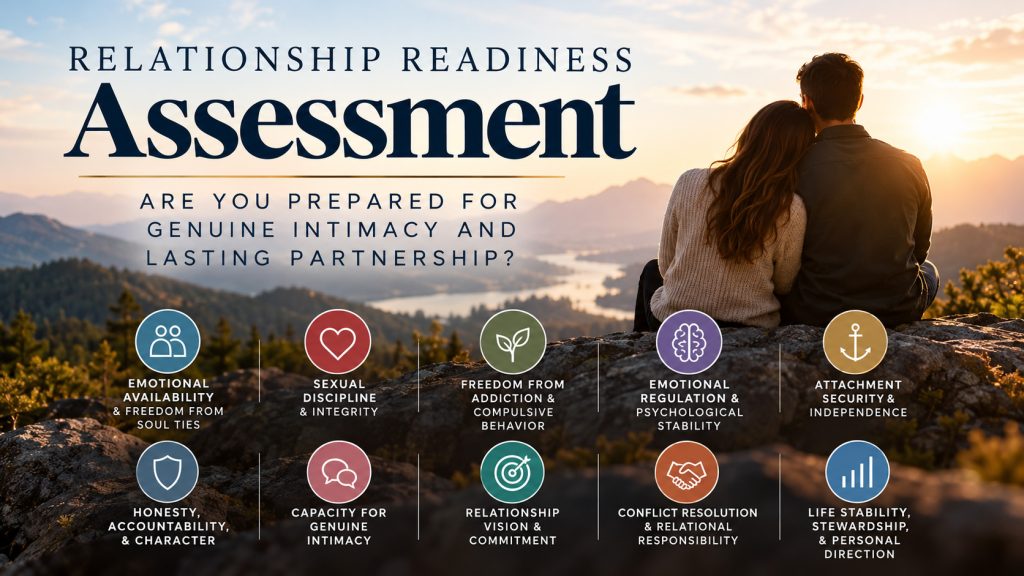
Relationship Readiness Assessment
Are You Prepared for Genuine Intimacy and Lasting Partnership?
Purpose: To evaluate your current readiness to enter and sustain a healthy, emotionally intimate, sexually faithful, and mutually supportive romantic relationship.
Core Principle: The desire for a relationship is not the same as readiness for a relationship.
Many individuals enter relationships with sincere intentions but carry unresolved attachments, destructive habits, emotional wounds, sexual patterns, or unrealistic expectations that interfere with their capacity for genuine intimacy. They may desire love while remaining unavailable to receive it, desire faithfulness while struggling with sexual discipline, or desire stability while remaining governed by fear and insecurity.
Relationship readiness is not the absence of imperfection. It is the presence of sufficient self-awareness, availability, integrity, emotional maturity, and willingness to grow so that a relationship can become a place of mutual flourishing rather than a means of escaping oneself.
This assessment examines ten dimensions of readiness. It is designed for individuals contemplating courtship, those entering a new relationship, or couples seeking to evaluate the foundations of their partnership.
Instructions
Read each statement and rate how accurately it describes your life over the past 90 days, rather than how you hope to behave in the future.
Use the following scale:
0 — Not True: This is not presently characteristic of me.
1 — Rarely True: I occasionally demonstrate this, but significant problems remain.
2 — Sometimes True: I demonstrate this inconsistently or am actively developing it.
3 — Mostly True: This is generally characteristic of me, with occasional difficulties.
4 — Consistently True: This is a well-established characteristic of my life.
Answer honestly. This assessment is not intended to establish your worth, diagnose a disorder, or determine whether you deserve love. Its purpose is to identify areas requiring attention before or during the development of a serious relationship.
Dimension 1: Emotional Availability and Freedom From Soul Ties
The capacity to become genuinely available to another person without remaining psychologically, romantically, or spiritually preoccupied with someone else.
I am no longer emotionally attached to a previous romantic or sexual partner in ways that interfere with forming a new relationship. ___ / 4
I do not regularly fantasize about, romanticize, monitor, or secretly hope to reunite with someone from my past. ___ / 4
I have accepted the end of previous relationships and no longer depend upon former partners for emotional reassurance or validation. ___ / 4
I am free from ongoing romantic fantasies about an imaginary or idealized partner against whom a real person would be unfairly compared. ___ / 4
I have resolved, or am responsibly managing, the legal, financial, relational, and practical entanglements that could interfere with a new partnership. ___ / 4
Dimension Score: ___ / 20
Dimension 2: Sexual Discipline and Integrity
The capacity to govern sexual desires in accordance with personal convictions, relational commitments, and respect for others.
My sexual behavior is consistent with the values and commitments I would want to bring into a serious relationship. ___ / 4
Pornography, sexual fantasy, masturbation, or other solitary sexual behaviors do not operate as compulsive patterns or substitutes for genuine emotional intimacy in my life. ___ / 4
I can experience sexual attraction and arousal without feeling compelled to pursue immediate gratification. ___ / 4
I do not pursue casual sexual encounters, flirtation, or sexual attention primarily to manage loneliness, insecurity, boredom, or emotional distress. ___ / 4
I regard potential partners as complete human beings and can honor their dignity, boundaries, and long-term well-being even when doing so requires sexual restraint. ___ / 4
Dimension Score: ___ / 20
Dimension 3: Freedom From Addiction and Compulsive Behavior
The degree to which addictive or compulsive patterns no longer govern behavior, undermine honesty, or compete with the responsibilities of partnership.
Alcohol, recreational drugs, gambling, pornography, or other potentially addictive behaviors do not interfere with my judgment, relationships, or daily responsibilities. ___ / 4
I do not depend upon substances or compulsive behaviors as my primary means of managing emotional discomfort. ___ / 4
I can acknowledge problematic habits honestly rather than concealing, minimizing, or rationalizing them. ___ / 4
When I recognize a destructive behavioral pattern, I am willing to seek support, establish boundaries, and take meaningful corrective action. ___ / 4
My current lifestyle demonstrates sufficient stability and self-regulation to fulfill the responsibilities of a committed relationship. ___ / 4
Dimension Score: ___ / 20
Dimension 4: Emotional Regulation and Psychological Stability
The ability to experience difficult emotions without allowing them to dictate destructive behavior.
I can experience loneliness, disappointment, jealousy, rejection, or uncertainty without reacting impulsively or destructively. ___ / 4
I can recognize and communicate my emotional needs without expecting another person to regulate my emotions for me. ___ / 4
I can tolerate relational uncertainty without becoming excessively controlling, demanding, avoidant, or preoccupied. ___ / 4
When emotionally overwhelmed, I have constructive ways of restoring perspective and emotional balance. ___ / 4
I take responsibility for understanding and addressing my psychological vulnerabilities rather than expecting a romantic partner to heal them. ___ / 4
Dimension Score: ___ / 20
Dimension 5: Attachment Security and Independence
The ability to form meaningful bonds without losing one’s identity or becoming governed by fear of abandonment or engulfment.
I can develop closeness with another person without becoming excessively dependent upon their attention or reassurance. ___ / 4
I can allow another person reasonable independence without interpreting it as rejection or abandonment. ___ / 4
I am comfortable expressing affection, vulnerability, and emotional needs without excessive fear of being hurt. ___ / 4
I can maintain my friendships, interests, responsibilities, and personal identity while developing a romantic relationship. ___ / 4
I do not habitually withdraw, pursue, test, manipulate, or sabotage relationships in response to attachment-related fears. ___ / 4
Dimension Score: ___ / 20
Dimension 6: Honesty, Accountability, and Character
The willingness to live truthfully, acknowledge wrongdoing, accept correction, and behave consistently with one’s values.
I am willing to disclose important information about my life that a serious partner would reasonably need to make an informed decision about a relationship. ___ / 4
I can acknowledge wrongdoing without immediately becoming defensive, blaming others, or constructing excuses. ___ / 4
My behavior remains reasonably consistent with my professed values even when nobody is watching. ___ / 4
I can receive criticism, correction, or difficult feedback without responding with contempt, retaliation, or withdrawal. ___ / 4
I take responsibility for repairing harm I cause rather than relying solely upon apologies, promises, or expressions of regret. ___ / 4
Dimension Score: ___ / 20
Dimension 7: Capacity for Genuine Intimacy
The ability to develop mutual understanding, emotional connection, vulnerability, and a shared experience of reality.
I am comfortable having meaningful conversations about fears, hopes, needs, disappointments, and personal vulnerabilities. ___ / 4
I can listen attentively to another person’s experience without immediately judging, correcting, defending myself, or redirecting the conversation toward my own needs. ___ / 4
I am interested in understanding who another person actually is rather than primarily who I imagine or hope they will become. ___ / 4
I can experience emotional closeness, companionship, and contentment without requiring constant excitement, novelty, sexual stimulation, or romantic intensity. ___ / 4
I am willing to be genuinely known, including my limitations, past mistakes, insecurities, and areas of ongoing growth. ___ / 4
Dimension Score: ___ / 20
Dimension 8: Relationship Vision and Commitment
The degree to which an individual possesses a clear, realistic, and intentional understanding of the partnership they desire.
I have a reasonably clear understanding of why I want a relationship and what kind of partnership I hope to build. ___ / 4
My desire for a relationship is motivated primarily by love, companionship, shared purpose, and mutual growth rather than fear of loneliness or the need for validation. ___ / 4
I understand that enduring relationships require sacrifice, patience, forgiveness, and consistent effort beyond the excitement of initial attraction. ___ / 4
I am prepared to evaluate compatibility thoughtfully rather than allowing sexual chemistry or emotional intensity to determine my decisions. ___ / 4
I am willing to make appropriate commitments and sacrifices to build a faithful, stable, and enduring partnership. ___ / 4
Dimension Score: ___ / 20
Dimension 9: Conflict Resolution and Relational Responsibility
The ability to navigate differences without undermining emotional safety, mutual respect, or trust.
I can express disagreement without resorting to insults, contempt, intimidation, manipulation, or personal attacks. ___ / 4
I can remain engaged in difficult conversations without routinely shutting down, withdrawing affection, or threatening to end the relationship. ___ / 4
I can recognize when my own fears, assumptions, or past experiences are influencing my interpretation of another person’s behavior. ___ / 4
I can respect another person’s boundaries, preferences, and perspectives even when they differ from my own. ___ / 4
I am willing to work collaboratively toward solutions rather than approaching conflict as a contest that one person must win. ___ / 4
Dimension Score: ___ / 20
Dimension 10: Life Stability, Stewardship, and Personal Direction
The degree to which one’s life possesses sufficient structure, responsibility, and direction to support a serious relationship.
I maintain reasonable responsibility for my financial obligations, employment, household, and daily affairs. ___ / 4
I have constructive routines that support my physical health, psychological well-being, and personal development. ___ / 4
I have a meaningful sense of direction or purpose that does not depend entirely upon being in a romantic relationship. ___ / 4
I have sufficient time, emotional energy, and practical availability to invest consistently in developing a serious partnership. ___ / 4
I am generally satisfied with the direction of my life and do not expect a romantic relationship to rescue me from circumstances I am unwilling to address. ___ / 4
Dimension Score: ___ / 20
Scoring and Interpretation
Each dimension contains five questions worth up to four points.
Maximum dimension score: 20
Maximum total score: 200
To convert your score to a 100-point scale, divide your total by two.
Relationship Readiness Score = Total Points ÷ 2
Dimension Profile
Dimension | Score |
|---|---|
1. Emotional Availability | ___ / 20 |
2. Sexual Discipline | ___ / 20 |
3. Freedom From Addiction | ___ / 20 |
4. Emotional Regulation | ___ / 20 |
5. Attachment Security | ___ / 20 |
6. Honesty and Character | ___ / 20 |
7. Capacity for Intimacy | ___ / 20 |
8. Vision and Commitment | ___ / 20 |
9. Conflict Resolution | ___ / 20 |
10. Life Stability | ___ / 20 |
Total | ___ / 200 |
Readiness Score | ___ / 100 |
Suggested Readiness Categories
85–100: Strong Relationship Readiness
You demonstrate substantial personal stability, emotional availability, integrity, and capacity for genuine partnership. You appear well-positioned to pursue a serious relationship thoughtfully, while recognizing that growth and mutual adaptation remain ongoing responsibilities.
70–84: Generally Ready, With Areas for Development
You possess many important foundations for a healthy relationship, although certain vulnerabilities may interfere with intimacy or stability. Identify the dimensions with the lowest scores and address them intentionally.
55–69: Developing Relationship Readiness
You demonstrate meaningful strengths, but several areas may create recurring difficulties in a serious partnership. A period of intentional personal development, increased self-awareness, and behavioral change may be beneficial.
40–54: Significant Readiness Concerns
Your responses suggest multiple unresolved challenges that could compromise emotional availability, integrity, stability, or the ability to sustain genuine intimacy. Prioritizing these areas before entering a serious commitment may be wise.
0–39: Foundational Personal Work Recommended
Your current circumstances or behavioral patterns may make a healthy, stable relationship especially difficult to establish or sustain. Focus on developing personal stability, resolving significant attachments, strengthening self-regulation, and addressing destructive patterns.
These scoring categories are proposed educational guidelines, not scientifically validated cutoffs. A high score does not guarantee relationship success, and a low score does not establish that a person is incapable of healthy love.
Important Interpretation Principle
Relationship readiness cannot be reduced entirely to a numerical score.
An individual might score highly across most dimensions while continuing to conceal an active affair, engage in serious dishonesty, violate another person’s boundaries, or struggle with an uncontrolled addiction. Such concerns may significantly compromise readiness regardless of the total score.
Similarly, someone actively recovering from addiction, managing a mental health condition, navigating a disability, or maintaining necessary contact with a former spouse for co-parenting should not automatically be considered unavailable or unready. The relevant considerations are honesty, stability, responsible management, personal boundaries, and the ability to participate in a healthy partnership.
Readiness is best evaluated through both the overall pattern and the seriousness of any particular concern.
Personal Reflection and Readiness Development
1. My Strongest Dimensions
Which three dimensions received your highest scores? How do these strengths prepare you to contribute to a healthy partnership?
2. My Greatest Vulnerabilities
Which three dimensions received your lowest scores? How have these vulnerabilities affected your previous relationships or your present capacity for intimacy?
3. Unresolved Attachments
Are there any previous partners, sexual experiences, romantic fantasies, or imagined relationships that continue to occupy emotional space within you? What would genuine freedom from these attachments look like?
4. Sexual Integrity
Would you feel comfortable honestly discussing your present sexual habits, boundaries, and values with someone you were seriously considering marrying? If not, what changes would help you approach that conversation with integrity?
5. Addictions and Avoidance
What behaviors do you turn toward when experiencing loneliness, stress, boredom, rejection, or emotional discomfort? Are these behaviors supporting your development or undermining it?
6. The Partner I Hope to Become
Rather than describing the characteristics you desire in a future partner, describe the characteristics you intend to bring into the relationship yourself.
7. My Readiness Commitments
Identify three specific changes you are willing to make over the next 90 days to improve your relationship readiness.
Commitment One: ______________________________________
Commitment Two: ______________________________________
Commitment Three: ______________________________________
Closing Reflection
A healthy relationship is not simply the union of two people who desire one another. It is the meeting of two individuals who possess sufficient availability, maturity, discipline, and integrity to begin building a shared life.
The purpose of becoming relationship-ready is not to achieve perfection or eliminate every vulnerability. It is to become increasingly capable of loving another person without using that person to escape oneself.
The fundamental question is not merely, “Am I ready to find the right person?” It is, “Am I becoming the kind of person who can participate in the relationship I hope to find?”