
Survival vs Connection
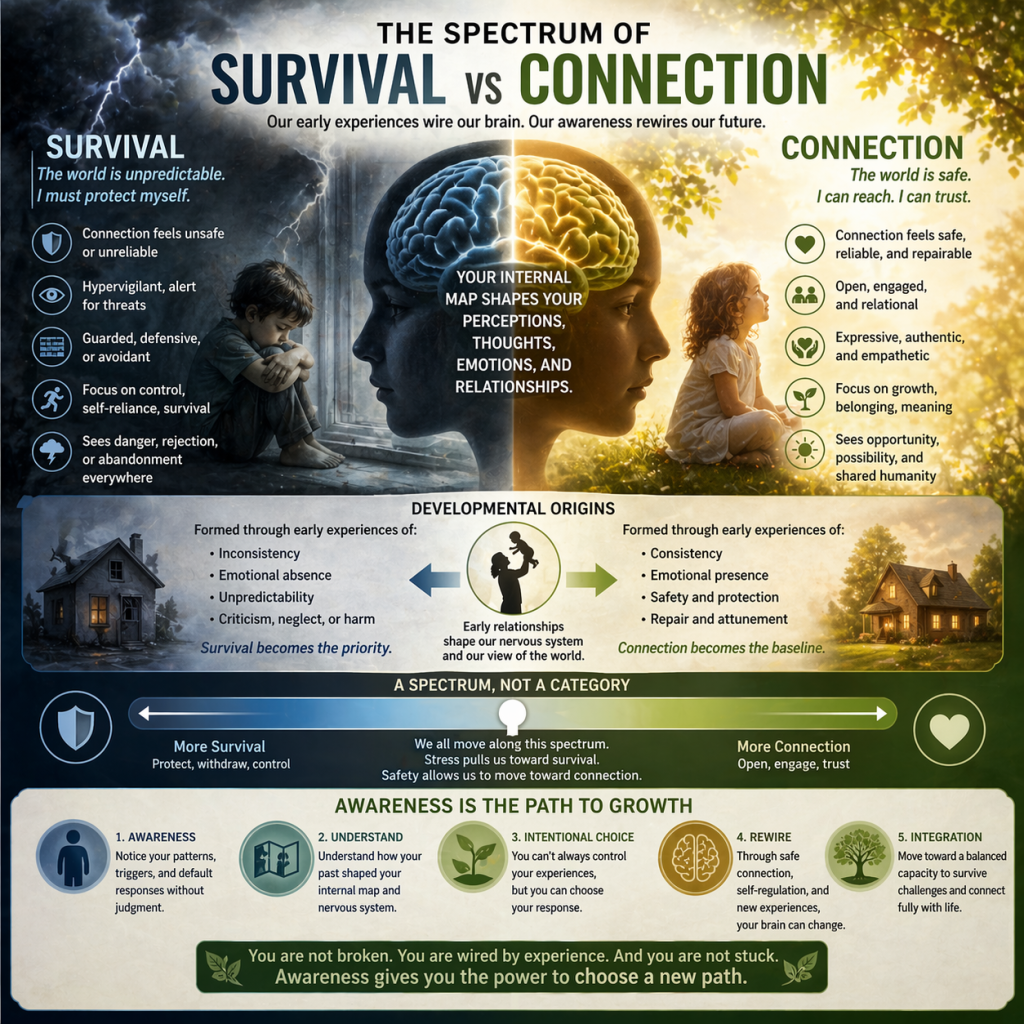
One factor that the Science of Psychology has made crystal clear is that our early emotional experiences are hyper predictive of our adult lives. Beneath our thoughts, decisions, and relationships, there is an underlying orientation that shapes how we interpret everything around us. At its most fundamental level, this orientation can be understood as a spectrum between survival and connection. It is not something we consciously choose in early life. It is something that is formed through experience, especially in our earliest relationships, and it becomes the lens through which we perceive reality.
The human brain is wired for survival, but how much we rely on others or ourselves for survival becomes dominant depends largely on developmental experience. When a child grows up in an environment where relationships are emotionally safe, consistent, and repairable, their nervous system learns that connection is reliable. They learn that closeness does not lead to harm, that conflict can be resolved, and that their needs can be expressed without rejection or instability. In this context, the brain organizes itself around connection. Trust becomes a baseline, not something that must constantly be defended. The individual can remain open, engaged, and relational even under stress, because their internal map tells them that connection is not a threat.
In contrast, when early experiences are marked by inconsistency, emotional absence, unpredictability, or harm, the brain adapts differently. It prioritizes survival. This does not always look dramatic or obvious. It often shows up in subtle but pervasive ways. The individual may become guarded, hyper aware of potential threats, or highly self reliant. They may struggle to trust, withdraw under pressure, or attempt to control their environment to reduce uncertainty. In these cases, connection is not experienced as safe or stable. It is experienced as something that must be managed, limited, or avoided. The brain learns that closeness carries risk, and survival becomes the primary organizing principle.
These patterns do not remain confined to childhood. They become embedded in what could be called a person’s cognitive map. This map shapes how they interpret others’ behavior, how they respond to stress, and how they engage in relationships. A person oriented toward connection may interpret ambiguity with curiosity and openness. A person oriented toward survival may interpret the same ambiguity as a potential threat. The difference is not in the external situation, but in the internal framework that has been built over time.
What makes this dynamic particularly powerful is that it operates largely outside of awareness. Most people do not recognize that they are perceiving the world through a survival or connection lens. They assume that their interpretation is simply reality. This is where distortion can take hold. A survival oriented individual may believe they are being realistic or cautious, when in fact they are reacting to patterns shaped by past experience. A connection oriented individual may underestimate risk or overextend themselves because their map assumes safety where it may not exist. In both cases, perception is filtered, and without awareness, that filter remains unquestioned.
The importance of awareness in this framework cannot be overstated. Growth does not begin by forcing oneself into a connection oriented posture or by suppressing survival instincts. It begins by recognizing where one currently stands on the spectrum. This requires honesty. It requires noticing patterns of thought, emotional responses, and relational behavior. Do you tend to move toward others or away from them under stress. Do you default to trust or suspicion. Do you seek understanding, or do you prepare for defense. These are not surface level preferences. They are indicators of how your system has been organized.
Once this awareness is established, it becomes possible to engage in intentional development. A survival orientation is not a flaw. It is an adaptation. At some point, it likely served a necessary function. But what was once protective can become limiting if it is carried forward without examination. Similarly, a connection orientation must be grounded in discernment to remain healthy. The goal is not to eliminate one in favor of the other, but to develop the capacity to move between them appropriately, rather than being unconsciously driven by one.
Ultimately, the spectrum of survival versus connection is not just about behavior. It is about perception. It shapes what we notice, what we expect, and how we interpret the actions of others. It influences whether we see the world as fundamentally safe or fundamentally threatening, whether we move toward relationship or away from it, and whether we lead from openness or defensiveness. By bringing this dynamic into awareness, a person begins to reclaim agency over how they relate to themselves and others. They are no longer confined to the patterns formed in early life, but can begin to build a more integrated and intentional way of navigating the world.
Want to see where you are on the Survival vs. Connection spectrum?