
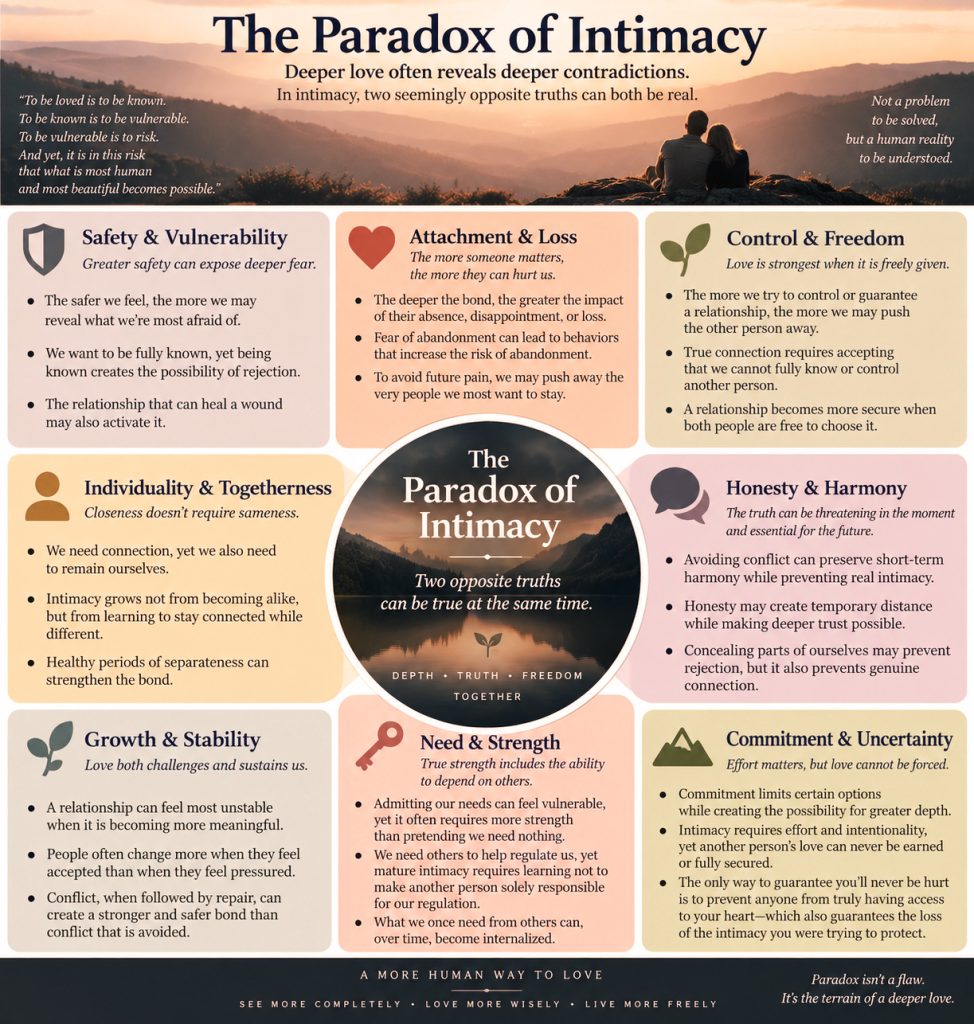
Relationships aren’t complicated at all, there are only 35 paradoxes.
“Why does getting closer to what we most deeply want often activate the very mechanisms that prevent us from receiving it?”
The Safety Paradox: The safer someone feels, we may feel safe enough to expose the parts of ourselves that are most afraid.
The Attachment Paradox: The more someone matters to us, the more power their absence, rejection, or disappointment has to hurt us.
The Healing Paradox: The relationship capable of helping heal an old wound may be the relationship that activates that wound most intensely.
The Vulnerability Paradox: We cannot experience profound intimacy without surrendering some of our protection against being hurt.
The Control Paradox: The more desperately we try to guarantee that someone will never leave, the more our controlling behavior may push them away.
The Abandonment Paradox: Fear of abandonment can produce behaviors that increase the probability of abandonment.
The Independence Paradox: Healthy intimacy requires the ability to depend on another person without making that person responsible for one’s psychological survival.
The Freedom Paradox: Love becomes more secure when both people know the other is free to leave but continually chooses to stay.
The Certainty Paradox: The deeper the relationship becomes, the more we must tolerate the fact that we can never completely know another person’s mind or guarantee the future.
The Trust Paradox: Trust requires accepting some risk before sufficient evidence exists to eliminate the risk.
The Disclosure Paradox: We want to be loved for who we truly are, but revealing who we truly are creates the possibility of rejection.
The Authenticity Paradox: Hiding undesirable parts of ourselves may protect us from rejection, but it also prevents us from ever knowing whether the real person would have been accepted.
The Conflict Paradox: Avoiding disagreement can preserve short-term harmony while preventing the honesty required for long-term intimacy.
The Boundary Paradox: Saying “no” can temporarily create distance while ultimately making greater closeness possible.
The Difference Paradox: Intimacy does not require becoming increasingly alike; mature closeness requires learning to remain connected while experiencing one another as genuinely different.
The Separation Paradox: Healthy periods of separateness can strengthen connection because each person returns to the relationship as a whole individual rather than an extension of the other.
The Need Paradox: Admitting that we need someone can feel weak, yet the ability to acknowledge healthy dependency often requires greater psychological strength than pretending not to need anyone.
The Strength Paradox: The stronger a person becomes internally, the safer it becomes to be emotionally vulnerable externally.
The Familiarity Paradox: The person we know best can eventually become the person we stop being curious about, causing familiarity itself to undermine intimacy.
The Novelty Paradox: Early romantic intensity can feel like extraordinary intimacy precisely when two people actually know relatively little about one another.
The Intensity Paradox: The strongest emotional reaction does not necessarily indicate the deepest connection; sometimes it indicates the deepest wound.
The Projection Paradox: The less we know someone, the easier it is to experience them as our ideal partner because imagination fills in what reality has not yet revealed.
The Desire Paradox: Desperately needing a relationship to succeed can make it harder to accurately determine whether the relationship should succeed.
The Acceptance Paradox: People often become more capable of change after they experience being accepted rather than when they experience pressure to change.
The Repair Paradox: A relationship that has experienced conflict and successfully repaired it can become safer than one whose apparent peace has never actually been tested.
The Forgiveness Paradox: Forgiveness can release resentment without requiring restoration of trust; reconciliation may still require evidence, accountability, and time.
The Reciprocity Paradox: Keeping score destroys generosity, yet repeatedly giving without reciprocity eventually destroys intimacy.
The Self-Love Paradox: Loving another person well requires temporarily placing their needs ahead of ours at times, while chronically abandoning ourselves eventually makes healthy love impossible.
The Truth Paradox: The truth can threaten a relationship in the moment while concealment threatens the relationship at its foundation.
The Exposure Paradox: We may believe we have healed an attachment wound while alone, only to discover its remaining depth when someone becomes important enough to activate it.
The Regulation Paradox: We need other people to help regulate us, yet mature intimacy requires learning not to make another person solely responsible for regulating us.
The Internalization Paradox: Healthy dependence on trustworthy people can eventually make us less dependent because their reassurance, wisdom, and acceptance become internalized.
The Commitment Paradox: Commitment restricts certain possibilities while simultaneously creating possibilities for depth that perpetual optionality cannot provide.
The Surrender Paradox: Intimacy requires effort, communication, discipline, and intentionality, yet another person’s love can never be earned or controlled through sufficient effort.
The Courage Paradox: The only way to completely guarantee that your heart will never be broken is to prevent anyone from truly having access to it, which guarantees the loss of the intimacy you were trying to protect.
See less